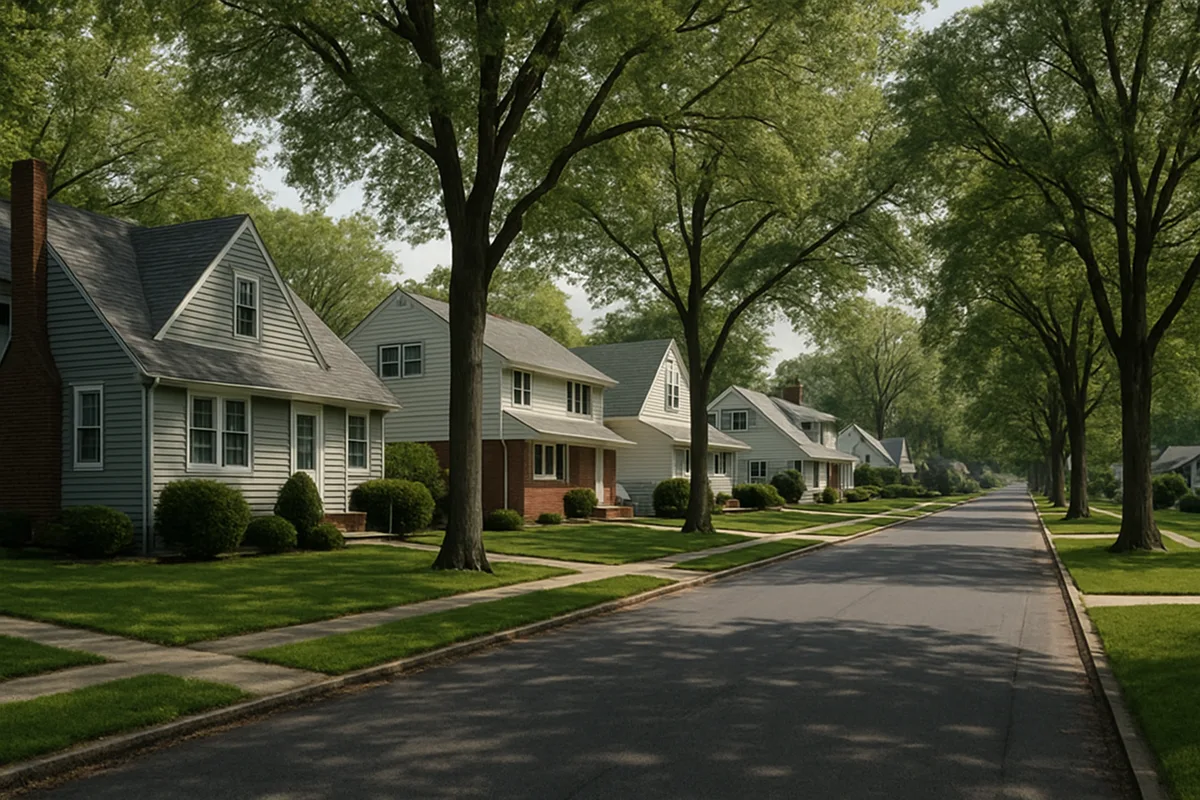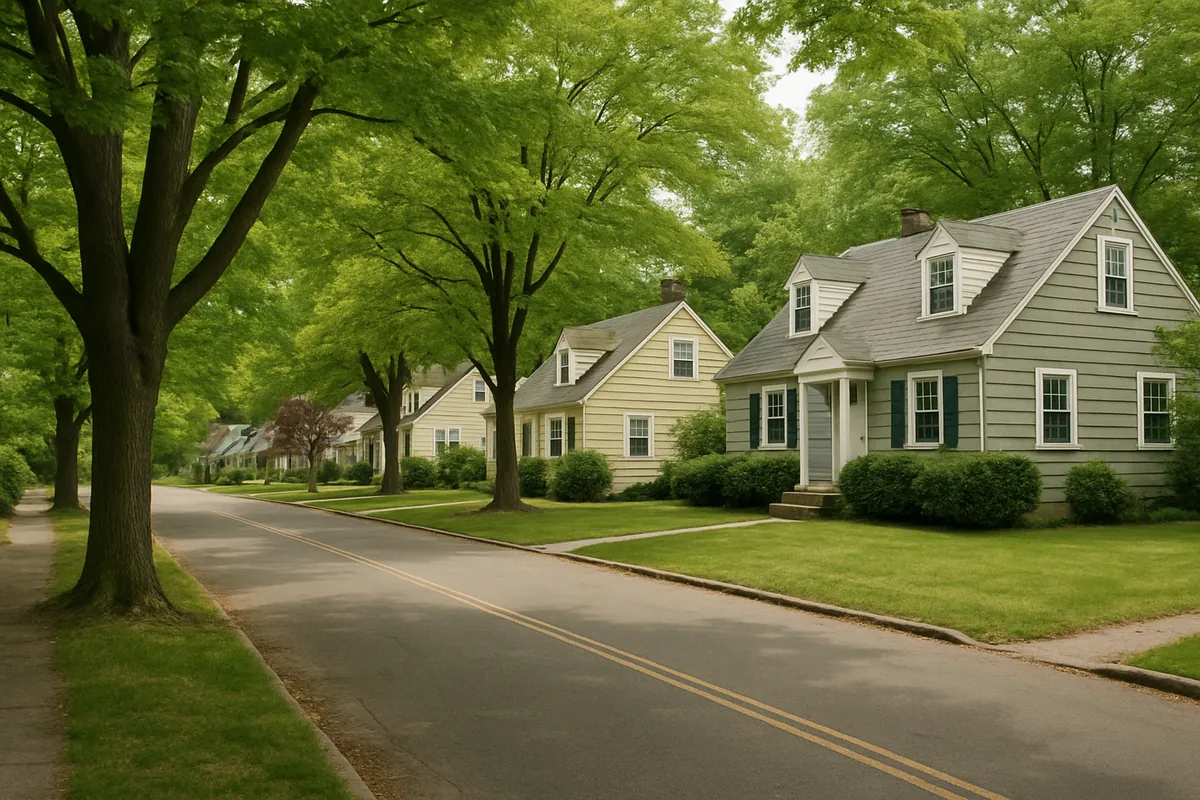
New City Trenchless covers inspection and lining options for the vitrified clay laterals under Valley Cottage’s ranch and cape subdivisions. Many went into the ground along the Route 303 corridor between the early 1950s and the mid 1960s and are now 60 to 70 years old. Pipe age and soil conditions together shape the likely failure pattern.
Laid Out Between Traprock and Wet Bottomland
Valley Cottage runs north to south in a band between two very different landscapes. On the east, Hook Mountain and the ridge above Rockland Lake State Park are part of the Palisades diabase sill, a sheet of hard igneous rock intruded into the softer sedimentary rock of the Newark Basin. USGS geologic mapping of the lower Hudson describes exactly this pairing, and you can feel the transition just driving from Kings Highway down toward the western side of the hamlet.
On the west, the ground falls away toward the Hackensack drainage and Lake DeForest, where soils are deeper, finer and wetter. Streets on the ridge side sit on shallow soil over rock. Streets on the valley side sit on deep soil that settles. A lateral buried in 1957 in one of those settings is not the same asset as an identical lateral buried the same year in the other.
Sixty Years Into a Sixty Year Pipe
Clay tile of that era was laid in short sections, which puts a joint every few feet along the run. The clay itself is nearly indestructible and clay pipe pulled out of the ground today is often still hard and intact. The joints are the weak point. Mortar and early compression joints loosen as the trench settles, and by the time a Valley Cottage lateral enters its seventh decade, essentially every joint on the run is a candidate defect rather than a reliable seal.
Orangeburg shows up here too, on the same streets and in the same years, because it was the cheap alternative during exactly this build-out. It fails differently: the fiber wall delaminates and slumps out of round instead of opening at joints, and once it has deformed it cannot be lined at all.
Ridge Side and Valley Side Fail Differently
| Ridge side, toward Rockland Lake | Valley side, toward Lake DeForest | |
|---|---|---|
| Ground | Shallow soil over diabase and rock ledge | Deeper, finer, wetter soil |
| Typical cover over the lateral | Whatever the rock allowed, often minimal | Normal trench depth |
| Dominant defect | Root intrusion, joint damage, crushed sections | Settlement, bellies, infiltration at joints |
| Open-cut penalty | High, rock excavation | High, saturated backfill and restoration |
| Method that usually wins | Full lateral lining | Lining if grade holds, bursting if it does not |
The table is why two neighbors half a mile apart get different recommendations from the same crew. It is also why the useful first step is never a quote, it is a sewer camera inspection with a locating sonde that fixes the depth and position of each defect before a method is chosen.
Sixty Years of Street Trees Growing Toward the Joints
The subdivision trees are the other half of the problem. Maples and oaks planted as saplings when these streets were new have had six decades to spread, and a mature tree’s roots reach well beyond the drip line of its canopy, as any Cornell Cooperative Extension guidance on tree root systems will tell you. A sewer lateral is an attractive target: warm, moist and nutrient rich, leaking slightly at every loosened joint.
Fine root hairs enter an offset joint, thicken into a mat inside the pipe, and catch grease and solids until flow stops. Cutting them restores service and changes nothing structural, because they regrow from the identical entry points. Tree root removal by cutting and jetting is the right emergency response and the wrong permanent plan. Sealing the joints is the permanent plan.
What Shallow Bedrock Does to the Repair Plan
Where rock sat close to the surface, the original crews laid the lateral at whatever cover they could get rather than at ideal depth. Two consequences follow decades later. A shallow lateral spends more of each winter inside the freeze-thaw zone, and it takes more load from vehicles and driveway traffic above it, which is where crushed clay sections come from.
The repair consequence is more useful. Open-cut on rock in this hamlet means breaking ledge, which is the most expensive way to move a few feet of ground in Rockland County. Rehabilitating the pipe inside the bore that was already blasted or picked out sixty years ago avoids all of it, which is why the price gap between trenchless and open-cut on the ridge side runs at the wide end of the usual 1.5 to 2 times.
Reline Now or Burst Later
The economics of an aging clay lateral are blunt. While the pipe still holds its shape, trenchless pipe lining builds a new jointless pipe inside the old one. An epoxy-saturated felt liner tube is inverted into the cleaned host pipe and cured ambient or with steam to the ASTM F1216 standard, then a robotic cutter reinstates the connections. One day of work, $4,000 to $12,000 for a full lateral, and the joints roots have fed on for decades stop existing.
Wait for a collapsed or deformed pipe and lining is off the table. The job becomes pipe bursting at $6,000 to $15,000, or open-cut at worse. A single bad joint in an otherwise sound run is still a $1,500 to $4,000 sectional repair, but that window closes as more joints open. Every year of waiting moves a Valley Cottage lateral one column to the right.
Before You Buy Here
Valley Cottage turns over steadily, and the houses changing hands are precisely the 1950s and 60s stock described above. A pre-purchase sewer inspection is the cheapest due diligence available on a house this age, because the lateral is the one major system a standard home inspection cannot see.
The same logic applies to the postwar streets in Congers just north of here, though Congers sits lower and wetter throughout. Head the other way toward Nyack and the housing gets far older than anything in Valley Cottage, which changes the conversation again.
Frequently Asked Questions
My Valley Cottage drains still work. Why inspect now?
Because the laterals here are 60 to 70 years old, and the difference between lining a sound pipe and bursting a collapsed one is thousands of dollars. A $250 to $500 camera inspection tells you which side of that line you are on.
Can roots be kept out of a clay lateral permanently?
Cutting alone, no; they regrow from the same joints. Lining seals every joint on the run at once, which removes the entry points instead of trimming the symptom.
How long does lining a Valley Cottage lateral take?
Most full-lateral linings finish in one day, and the line is back in service the same day the cure completes.
There is rock close to the surface in my yard. Does that rule out trenchless?
It argues for it. Rock is what makes open-cut expensive and slow on the ridge side of Valley Cottage, and lining or bursting works inside the bore that was already cut through it decades ago. Rock does affect where access pits can go, which is part of what the inspection establishes.
I am buying a 1950s house here. Is a sewer inspection worth it before closing?
On housing stock this age, yes. A pre-purchase camera inspection costs $250 to $500 and answers a question a general home inspection cannot, because nobody can see a lateral from the basement. Finding a deformed line before closing is a negotiating position; finding it afterward is a bill.