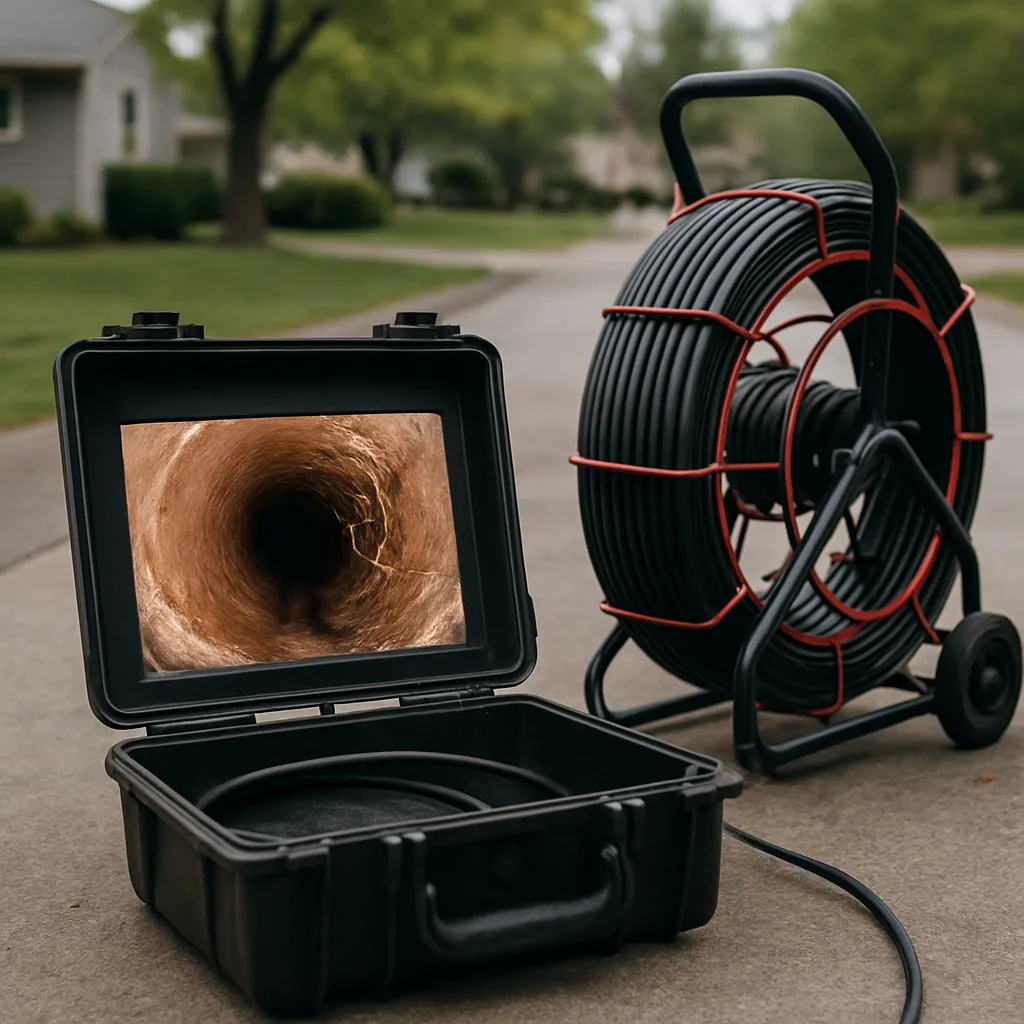
New City Trenchless explains how a self-leveling CCTV camera and locating sonde turn a mystery backup into a named defect with a distance and depth. Decisions between lining, pipe bursting and sectional repair should start with what the camera shows. Ask the inspecting provider for a copy of the footage and defect log.
How the Camera Gets Down the Line
Access is through an existing cleanout where the house has one, ideally a two-way cleanout that lets the head travel toward the house and toward the street from the same opening. Older Rockland homes without an outside cleanout are inspected through a pulled house trap or a roof vent, and each of those routes costs some reach, because the head has to negotiate more fittings before it gets to the run that matters.
A push camera on a semi-rigid fiberglass rod handles the typical 4 inch residential lateral. A motorized crawler takes over in 6 inch and larger commercial lines, where a push rod runs out of column strength before it runs out of pipe. The self-leveling head keeps the picture upright, which matters: a defect at the 6 o’clock position of the pipe means something different from the same defect at 12 o’clock, and you cannot tell them apart on a rolling image. The footage counter records the distance to everything the head passes, from the first wye fitting to the lateral tap connection at the sewer main.
Clearing the Line Before the Lens Goes In
A camera in standing sewage is a camera looking at brown. If the line is blocked or holding water, it gets cleared first, by cable auger where the obstruction is a root mass or a rag, or by hydro jetting where the wall is coated in grease and scale.
That order also protects you from a common misread. Heavy grease can hide a crack completely, and an unwashed wall can make ordinary staining look like a defect. Inspecting a clean pipe is the only way to tell a line that needed cleaning from a line that needs replacing.
What Defects Look Like on Screen
Root intrusion
Fine roots read as a pale curtain across the picture; a mature mat fills the bore like a scouring pad. Roots almost always enter at the joints of vitrified clay pipe, so the camera also counts how many joints are compromised, which decides cleaning versus lining.
Offset and separated joints
The far pipe end appears stepped off center, a dark crescent at the top or bottom of the bore. A small offset catches paper and grease. A large one exposes open soil, which is both an infiltration path and a sign that the trench bedding has moved.
Bellied pipe
The lens dips underwater and surfaces again. The length of submerged footage measures the belly, and standing water at the same counter mark on a return visit confirms the pipe slope is gone rather than the line just being wet.
Deformed Orangeburg
The round bore goes egg-shaped and the walls look blistered or wrinkled. Bituminized fiber pipe fails by losing its shape, and once the camera shows ovality, cleaning buys months, not years.
Scale and channeling in cast iron
Scale buildup narrows the bore with a rough, rusty ring. Channeling shows as a worn trough along the bottom of the pipe, the wall thinning where sixty years of flow has run.
From Picture to Method
| On screen | What it means | Usual method |
|---|---|---|
| Roots at one joint, clean pipe either side | Localized entry point | Root cutting, then a sectional sleeve |
| Roots at joint after joint down the run | The whole line is porous | Full lateral CIPP lining |
| Rusty ring narrowing the bore | Cast iron scale | Descale, then line |
| Egg-shaped, blistered wall | Deformed Orangeburg | Pipe bursting replacement |
| Lens submerges and resurfaces | Belly, slope is lost | Excavate that section, or burst if the sag runs long |
| Soil visible through the wall | Hole or separated joint | Sleeve if short, burst if the run has failed |
This table is the whole reason the inspection exists. Every row leads somewhere different, and the spread between them is the difference between a four figure invoice and a five figure one, so guessing is expensive and looking is not.
What $250 to $500 Buys
A sewer camera inspection in New City commonly runs $250 to $500, and some providers credit it against repair work. Compare that with exploratory digging and it is usually the least expensive decision on the job. Grease blockage, infiltration at a joint, an offset joint and a full collapse each show on screen before anyone quotes a firm number.
It is also the only honest way to be told you do not need a repair. A line that scopes clean gets written up as clean, and clearing a one-off blockage in sound pipe is a drain cleaning invoice, not a trenchless project.
From Screen Distance to a Mark on the Lawn
The camera head carries a locating sonde, a small transmitter broadcasting a fixed low frequency tone. A receiver at the surface reads its signal and converts a defect at 43 feet on the counter into a paint mark on the grass with a depth written beside it.
That locate is what keeps a quote honest. A sectional point repair is only cheaper than a full lining if the failure really is confined to one spot, and the sonde proves where the spot is and how deep an access pit would need to be. It also answers questions that have nothing to do with the sewer: whether the line runs under the driveway you are about to repave, whether it crosses a neighboring lot, and whether the tree you were told to remove is actually anywhere near the pipe.
The Handover: Your Footage, Your Defect Log
Request the full recording and a written defect log that lists each observation against its footage distance, in the spirit of the PACP coding system published by NASSCO and used by municipal inspectors on sewer mains. Coded observations travel better than adjectives and can be handed to another contractor, an attorney or an adjuster.
That file has uses beyond the first quote. It supports an insurance claim, anchors a seller credit on a house purchase, answers a sewer lateral easement question, and helps with a second opinion. If you are buying rather than fixing, the same scope run under contract is a pre-purchase sewer inspection, and the report is written with the negotiation in mind.
What a Camera Cannot Tell You
An honest inspection report has limits, and they are worth stating. The lens sees the inside surface, so it cannot measure remaining wall thickness in cast iron, and it cannot tell you how many more winters a cracked clay hub has left. It shows that a pipe holds water but not the exact grade of the run, which is why a suspected belly is sometimes confirmed on a second visit rather than on the first.
It also sees only the pipe, not the ground around it. Aging clay and iron laterals sit inside a larger public network whose condition is graded nationally by the American Society of Civil Engineers infrastructure report card, and infiltration through private laterals is part of why the EPA treats inflow into sanitary sewers as a system-wide problem. Locally, the mains belong to Rockland County Sewer District No. 1 and the lateral to the tap belongs to you, so the camera’s job stops at the tap and the report says so.
In postwar Valley Cottage and the tract streets around it, the lens almost always comes back with one of three materials on screen, clay, cast iron or Orangeburg, and the log records which one is under your lawn, because the material decides the repair as much as the defect does.
Frequently Asked Questions
How much does a sewer camera inspection cost in New City?
$250 to $500 is a common range. Some providers credit the inspection against repair work. The scope should cover the full lateral, sonde locating and the recording.
Do I get to keep the video?
Ask for the full recording and a defect log noting the distance to each problem. It can support an insurance claim, seller negotiation or second opinion.
Can the camera get through a blocked line?
Only up to the blockage. If the line is fully closed it must be cleared first with an auger or hydro jetter. A camera pushed into standing sewage sees nothing useful.
How do you know how deep the pipe is?
The camera head carries a locating sonde. A receiver at the surface reads its signal and gives position and depth, so a defect at 43 feet on screen becomes a paint mark on the lawn with a depth figure beside it.
My house has no outside cleanout. Can you still inspect?
Usually yes. Access can be through a pulled house trap plug, a basement cleanout on the house drain, or a roof vent stack, each with tradeoffs on how much of the line the head can reach. If none of those work, installing an exterior two-way cleanout is worth doing anyway, because every future service call gets cheaper once it exists.