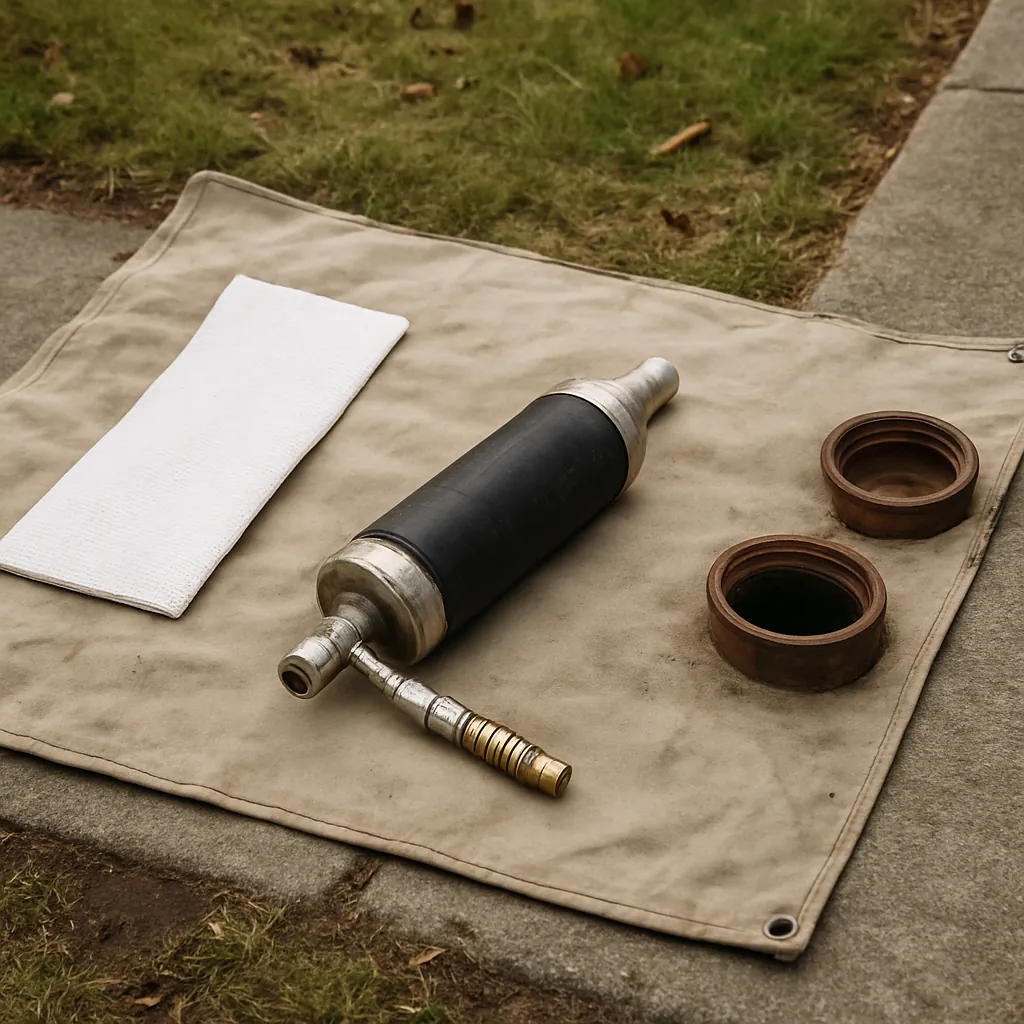
New City Trenchless explains sectional point repair sleeves, short lengths of fiberglass saturated with epoxy resin and cured against the host pipe wall at a single failed joint. Clay tile went into Rockland County trenches in short segments, which puts a joint every few feet of run, and it takes only one of them to shift, leak or let roots in. When the camera shows one bad joint in an otherwise serviceable line, repairing four feet can make more sense than lining sixty.
What a Sectional Sleeve Fixes and What It Cannot
A point repair sleeve handles localized defects: an offset joint where trench soil settled, root intrusion concentrated at one hub, a radial or longitudinal crack, a hole where a piece of clay has spalled out of the wall, or infiltration seeping in at a single connection. Roots get cut out first; the sleeve then seals the entry path so they cannot return.
The sleeve is the wrong tool for problems that run the length of the pipe. A bellied pipe keeps its sag because the sleeve follows the existing pipe slope rather than restoring fall. Channeling along the bottom of a cast iron run needs descaling and full lining. Deformed Orangeburg will not hold a sleeve any better than it holds a full liner, so that material gets replaced by pipe bursting instead.
One more limit turns some sleeve quotes into replacement quotes on the day. A sleeve needs sound host pipe on both sides of the defect to press against, so a joint that has pulled apart far enough to leave bare soil between the pipe ends has nothing to seal to. And when the inspection turns up three or more separate defects, lining the whole lateral usually wins on price per foot anyway.
Reading the Line Before Anyone Quotes a Sleeve
Choosing a spot repair is a counting exercise, not a judgment call, and the count comes off the camera inspection. The footage counter records the distance to every observation, so the report answers three questions: how many separate defects exist, how far apart they sit, and whether the pipe either side of each one is intact.
Defects clustered within a few feet can be covered by one longer sleeve or two overlapped ones. Defects spread across a 60 foot run cannot, and pretending otherwise is how a homeowner pays for three sleeves and then a full liner two years later. Municipal inspectors code sewer condition against the PACP system published by NASSCO, so a defect gets described by type, severity and location rather than by adjective.
Sizing the Sleeve to the Defect
Sectional liners come in set lengths, commonly 2, 3, 4 and 6 feet, and in diameters that cover the 3 and 4 inch residential lateral, the 6 inch run, and larger commercial pipe. The rule that governs which one goes in is overlap: the sleeve has to land on sound pipe for several inches beyond each end of the defect, so a two foot crack does not get a two foot sleeve.
Cured wall build is roughly 3 to 6 mm, so a 4 inch pipe does lose a little bore. What it gains is a smooth resin surface in place of a rough, root-scarred clay hub, and that carries flow better than the pipe did in its degraded state.
How a Point Repair Sleeve Goes In
The line is cleaned first, a hydro jetting pass that cuts roots back and returns the wall to bare surface so the resin can bond. Grease film or a root hair mat left in place is a bond failure waiting to happen.
A fiberglass mat is then saturated with resin and wrapped around an inflatable packer. Guided by the CCTV camera and a locating sonde, the packer travels through an existing cleanout to the exact footage mark of the defect and inflates, pressing the wet sleeve tight against the pipe wall and squeezing resin into the crack or the open joint. The resin cures at ambient temperature, the packer deflates and comes out, and what stays behind is a hard structural band bridging the failed joint. The camera goes back down afterward to confirm the edges laid flat and the bore is clear. No digging, and the work is done in a day, usually in hours.
Cure Windows in Cold Rockland Ground
Resin cure is temperature dependent, and a lateral buried 3 to 6 feet down sits in soil that stays in the 40s and low 50s Fahrenheit for much of the year here. Cold ground lengthens the hold time, so a January repair may use a faster hardener, a warmed packer, or simply a longer wait before the packer comes out.
The failure mode from rushing it is a soft or wrinkled edge that a drain auger later catches. The materials themselves come from the same cured-in-place family covered by the ASTM standards that govern full-length lining, principally ASTM F1216, so the chemistry is proven. The discipline is in giving it the time the ground temperature demands.
Sewer Line Spot Repair Cost in New City
| Option | Typical cost | When it wins |
|---|---|---|
| Camera inspection | $250 to $500 | Always first, often credited against the repair |
| Sectional spot repair | $1,500 to $4,000 per sleeve | One or two isolated defects in otherwise sound pipe |
| Full lateral CIPP lining | $4,000 to $12,000 | Three or more defects, or root entry along the whole run |
| Pipe bursting replacement | $6,000 to $15,000 | Deformed Orangeburg, collapse, or lost grade |
| Open cut of the same defect | Often 1.5x to 2x the trenchless price | Rarely, and only where the dig is genuinely easy |
Position within the range comes down to depth, diameter and access. A defect eight feet from a two-way cleanout sits at the bottom. A defect fifty feet out, under a driveway, with no exterior cleanout, sits at the top, because access work gets added to the sleeve itself.
The comparison that actually matters is the second row against the third. With one defect the sleeve wins clearly. With two it can still win. At three or more the full liner costs about the same and renews everything at once, which is why the $250 to $500 camera inspection that makes the call is money spent before, not after, the quote.
Sleeve Edges, Overlap and Old Patches
The sleeve materials are the same family used in full cured-in-place work under ASTM F1216, so a spot repair is a decades-scale fix, not a stopgap. The edges of a properly installed sleeve taper down to the host pipe wall, and that detail matters twice: a drain auger passing through later will not snag the transition, and a future full liner can be installed straight over the sleeve if the rest of the line eventually fails. Sleeves can also be overlapped to cover a defect longer than a single sleeve.
One Rockland detail shows up on these jobs repeatedly. Postwar houses commonly leave the foundation in cast iron and change to clay tile a short distance outside the wall, and that material transition is a favorite single-defect location, because two pipes of different stiffness moving against each other through sixty freeze-thaw cycles is exactly the joint that opens first.
Where Spot Repairs Fit Across Rockland Housing Stock
The mains here are maintained by Rockland County Sewer District No. 1, but the lateral from the house to the tap belongs to the homeowner, so the method choice is yours. In Nanuet and the rest of the tract housing built out after the Tappan Zee Bridge opened in 1955, a typical lateral is 40 to 80 feet of clay tile with a joint every few feet, and single-joint failures under a mature street tree are the everyday case. That is the profile a sectional sleeve was designed for.
The older river villages read differently. Pre-1940 and 19th century houses sit on longer, deeper laterals often patched once or twice already by previous owners, sometimes in mixed materials. There a sleeve is more likely to be one line item in a plan than the entire plan, and the camera log tells the two situations apart.
Frequently Asked Questions
How much does a sewer line spot repair cost in New City?
$1,500 to $4,000 per sleeve, against $4,000 to $12,000 for lining the full lateral. The camera inspection runs $250 to $500 and is often credited against the repair.
How long does a sectional point repair take?
Usually a few hours through an existing cleanout, one day at most including the camera work and cleaning.
Can a spot repair fix a belly in the line?
No. The sleeve hardens against the pipe in its current position, so a sag stays a sag. Bellies need excavation of that section, or pipe bursting if the sag runs long.
Will a spot repair work on Orangeburg pipe?
Rarely. Deformed bituminized fiber will not hold a sleeve to a round shape, so failed Orangeburg is normally replaced by pipe bursting instead.
How long does a point repair sleeve last?
The cured sleeve uses the same resin and fiberglass family as full CIPP lining, with a service life measured in decades. It can also be lined over later if the rest of the pipe fails.
Does a sleeve make the pipe narrower?
Slightly. A sectional sleeve builds roughly 3 to 6 mm of wall, so a 4 inch clay pipe loses a little bore. The cured resin surface is far smoother than sixty year old clay, so flow through the repaired section is normally better after the work than before it.