New City Trenchless explains how tree roots are removed from sewer laterals and why the joints they entered through may also need sealing. On the vitrified clay pipe under many Rockland County yards, cutting alone is maintenance rather than a lasting repair. This page covers what each root treatment actually accomplishes and where its limits are.
How Roots Get Into a Lateral in the First Place
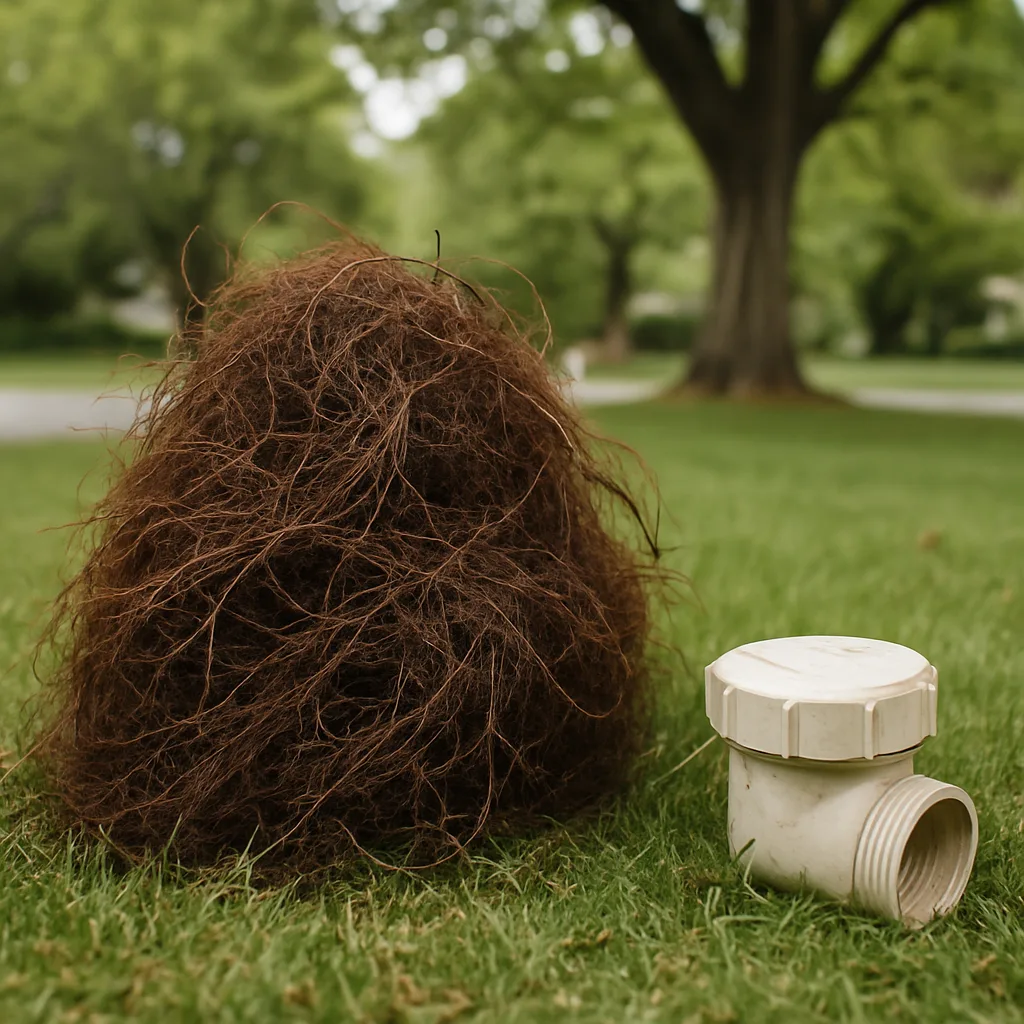
Roots do not smash their way into a sound pipe. They follow moisture. Clay tile was laid in short sections with a joint every few feet, and as trench soil settles, an offset joint begins to weep. That slow exfiltration of warm, nutrient-rich vapor is a beacon. A root tip enters as a hair, thickens inside the joint, and spreads into a mat that catches paper and grease until flow stops. The same weeping joints work in reverse during wet weather, letting groundwater infiltration in around the root mass, which is why a line with roots often also runs unexplainably full during a storm.
Freeze-thaw cycling widens the opening a little each year. Soil under the pipe heaves and relaxes, the joint that was tight in year twenty is weeping in year forty, and the root that could not get in earlier now can.
Cast iron pipe holds roots off along its barrel but gives them a way in at the lateral tap connection and at wye fittings. Orangeburg pipe admits them anywhere its laminated wall has begun to delaminate, which on a pipe made ten miles from here and installed under these subdivisions through the early 1970s is most of its length.
Which Trees Do It, and How Far They Reach
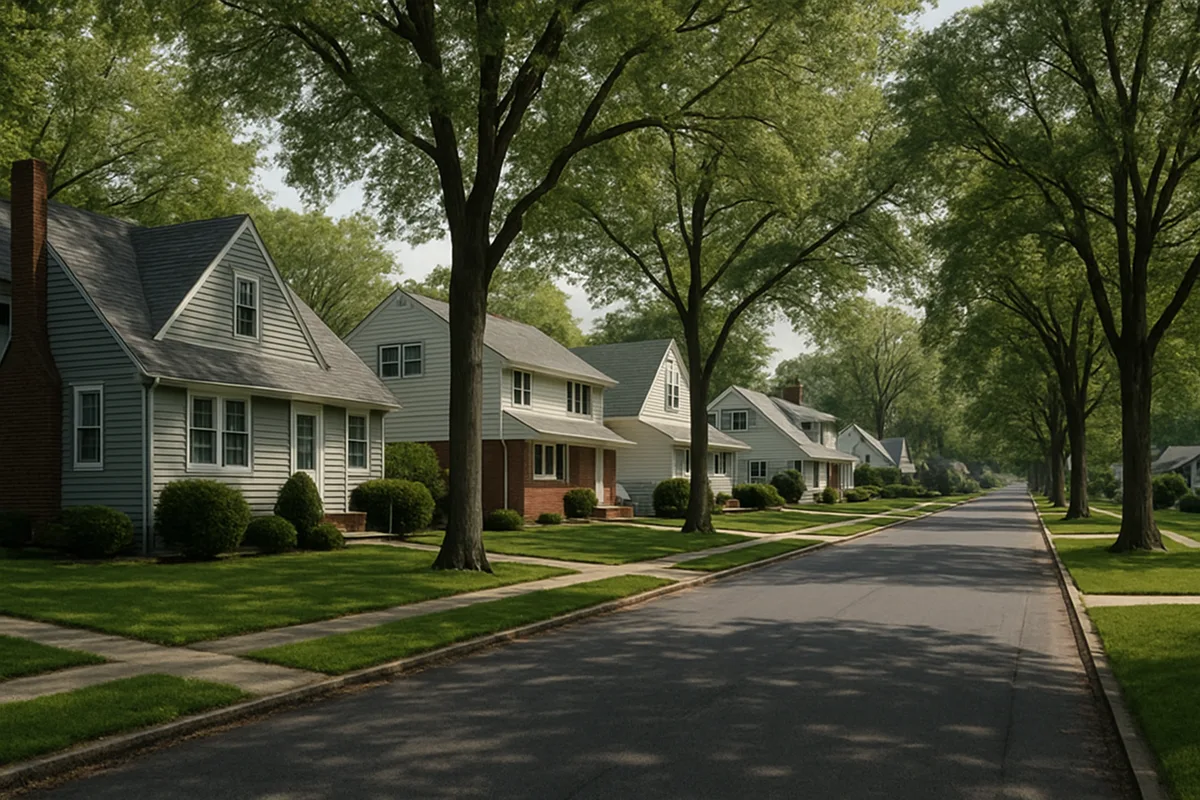
The mental picture most people carry is wrong in one important way. Tree roots are not a mirror of the canopy going straight down. The bulk of the absorbing root system sits in the top foot or two of soil and spreads well past the drip line, often two to three times the radius of the crown, which is why a tree standing across the lawn from the sewer line is still a suspect. Root biology and species behavior of this kind are the sort of thing Cornell Cooperative Extension publishes for New York homeowners, and it is worth reading before anyone talks you into removing a healthy tree.
| Tree | Behavior around laterals |
|---|---|
| Silver and Norway maple | Dense shallow fine roots, aggressive, common street trees in postwar Rockland subdivisions |
| Willow | Strongly moisture-seeking, the classic offender near wet ground and low-lying lots |
| Poplar and cottonwood | Fast growing, wide shallow spread, quick to refill a cut joint |
| Sycamore | Large mature root plates, common along the older river village streets |
| Oak | Deeper rooted and slower, less frequent as a lateral problem but not exempt |
None of this makes a tree the villain. A sound pipe with tight joints can sit under a maple for decades. The tree only becomes a sewer problem once the pipe gives it a door.
Cutting, Jetting and Foam: What Each One Actually Buys
Mechanical cutting
A drain auger fitted with a C-cutter or expanding blade shears the root mat and restores flow the same day. It is the right first move for a blocked line. It also leaves live root faces sitting in an open joint, and a blade sized to the pipe cuts a cylinder, not the pipe wall, so fine hairs stay behind at the joint face.
Hydro jetting
A hydro jetter with a rotary root-cutting nozzle shears the mat flush with the wall and flushes the debris out of the run, cleaning the pipe far better than a blade alone. That matters twice: a clean wall is what a camera can read, and it is what a liner can bond to. A line that will be repaired gets jetted whether or not it is blocked.
Foaming herbicide, treated honestly
Root control foams use registered active ingredients and kill root tissue they contact inside the pipe, slowing regrowth. They are pesticides governed by federal and New York rules, so label directions and licensed application requirements matter. Foam does not close the joint, so it is maintenance rather than a structural repair.
Reading the Footage: Finding Where the Roots Actually Entered
Clearing the line is when the real diagnosis becomes possible, because roots have to come out before the camera can see the joint they came through. A proper sewer camera inspection logs each intrusion against the footage counter and codes it in the standard format used across the industry: fine hair roots, a tap root through a single crack, or a full mass filling the bore, and whether the entry is at a pipe joint or at a branch connection.
That distinction changes the repair. Roots at one joint may support a spot repair, while roots at several joints may support lining. A sonde in the camera head provides the surface position and depth of each entry point, which makes sectional repair possible without opening the whole run.
Sealing the Entry Joints Is the Actual Repair
One or two bad joints get a sectional point repair: a short epoxy-saturated sleeve positioned over the joint on a packer and cured in place, bridging the opening with a new jointless section.
Roots at several joints along the run call for full cured-in-place pipe lining to ASTM F1216, a continuous jointless tube built inside the host pipe. Cured epoxy resin has no seam to reopen, so the roots outside stay outside. A robotic reinstatement cutter reopens any branch connections from inside, and the finished line is filmed so you can see every sealed joint.
The arithmetic worth doing is simple. Clearing the line is the cheap part. A few years of repeat cuttings through the cleanout, plus the one backup that happens on a Sunday, can quietly cost more than sealing the joint once.
What Sealing Does Not Fix
A liner is a sealed pipe, not a new grade. It closes the root doors along the section it covers and nothing more, so it is worth being clear about the limits:
- A belly still holds water after lining, because slope is set by the trench, not the pipe wall
- Roots can still enter downstream of a partial liner, at the next unsealed joint or at the tap
- Orangeburg that has deformed out of round cannot host a liner at all and needs replacement instead
- A collapsed section has no bore to work through and is a bursting or excavation job
This is why the scope is written off the footage rather than off the length of the driveway. Lining ten feet of a fifty foot lateral that has roots at both ends solves half a problem.
Mature Street Trees in the River Villages
Nyack, Piermont and Tappan carry some of the county’s oldest laterals under some of its oldest street canopies. Maples and sycamores planted when those villages were built now push root plates far beyond the drip line, and on the Hudson slope, where the water table sits high in the low blocks near the river, every weeping clay joint within reach gets found quickly.
New City’s subdivisions sit on the same clay and Orangeburg-era pipe found elsewhere in the county. Root removal and joint sealing should be evaluated together because cutting the roots does not close the opening they used.
Frequently Asked Questions
Do root killing foams actually work?
They do what they say and nothing more. A foaming herbicide kills the root tissue it touches inside the pipe and slows regrowth, but the joint the roots came through stays open. Foam is reasonable maintenance between cuttings. It is not a repair, and a foamed line will not stay clear indefinitely.
How long after cutting do roots grow back?
There is no fixed schedule. It depends on the tree species, how close it stands and how wide the joint has opened. A vigorous maple can refill a joint within a growing season or two. That is why cutting is maintenance and sealing the joint is the repair.
Can roots get into cast iron or Orangeburg pipe too?
Yes. Cast iron resists roots along the barrel but admits them at the lateral tap connection and at wye fittings. Orangeburg is worse: once the laminated fiber wall starts to delaminate, roots grow through the wall itself, not just the joints.
Do I have to remove the tree to fix the sewer line?
No. The fix happens inside the pipe. Once the entry joints are sealed with a cured liner there is nothing for the roots to grow into, and the tree stays where it is.
What does tree root removal from a sewer line cost?
Cutting or jetting the line clear is generally the least expensive first step. A camera inspection commonly runs $250 to $500. Sealing one entry joint with a sectional repair may run $1,500 to $4,000, while full-lateral lining may run $4,000 to $12,000 when roots enter at multiple joints.
Is root intrusion an emergency?
Not usually. A root mat closes a line gradually, so the warning signs arrive first: slow drains, a gurgling toilet, a basement floor drain that weeps during heavy use. Once sewage is backing up into the house it is an emergency, and the same root mat is generally still the cause.