New City Trenchless explains cured-in-place pipe lining (CIPP), an epoxy-saturated felt or fiberglass tube formed and hardened inside a failing host pipe. The method can rehabilitate vitrified clay and cast iron laterals common under Rockland County’s postwar streets. Many residential installations take one working day, but timing depends on access, preparation, pipe condition and cure method.
What the Liner Is and What It Becomes
The liner starts as a flexible felt tube, cut to the length and diameter the camera survey measured, then saturated with two-part epoxy resin under controlled vacuum so the wall is wet through with no dry spots. Dry spots matter: they cure into weak zones that can delaminate from the pipe wall years later, so wet-out is checked before anything goes downhole.
Felt holds air in its fibers, and air left in the tube becomes a void in the finished wall, so the tube is drawn under vacuum through a nip roller set to the design thickness. From that moment it is on a clock.
Once cured, the liner is a structural pipe in its own right under ASTM F1216, the ASTM International standard governing rehabilitation by an inverted and cured resin-impregnated tube. It does not depend on the old pipe for strength. Root entry points, offset joints and hairline fractures in the host are sealed behind a wall with no joints for roots to find again.
Cleaning and Coding the Host Pipe Before Any Resin Moves
Resin bonds to a clean wall and to nothing else, so everything the liner is supposed to do rests on the hours before the tube arrives. The sequence is mechanical first, then hydraulic. A root cutter on a flexible shaft or a chain knocker takes out the root mass and any protruding tap intrusion. Descaling heads pull scale and tuberculation off cast iron back toward bare metal. Then hydro jetting flushes the debris downstream and cuts grease off the crown.
A closing sewer camera inspection pass then codes the run to the PACP system published by NASSCO, which gives every crack, offset joint, root intrusion and infiltration point a standard code, a clock position and a distance from the access. That footage sets liner length, diameter, wall thickness and the station of every branch to be reinstated after cure.
Which Rockland County Laterals Can Be Lined
Lining needs a host pipe that still holds its shape. That makes it the right call for most clay laterals with root-invaded joints, and for cast iron pipe lining where the bore has narrowed with scale or channeled along the invert, once mechanical cutting and jetting have returned the wall to bare metal.
Rockland’s clay laterals went in as short lengths with a mortared hub and spigot joint every few feet, and those joints are the failure surface that sixty years of freeze-thaw cycling and street tree roots find. The barrel is often still sound while the joints are open, which is the ideal lining candidate: a strong host with a leaking geometry.
It is the wrong call for a collapsed pipe, or for Orangeburg squeezed too far out of round for a liner to press against. Those runs get pipe bursting instead. A bellied pipe sits in between: the liner follows the sag rather than correcting the fall, so a short belly gets lined with that understood, and a long one argues for bursting.
Ovality decides more than age does
A liner is inflated round. If the host has gone oval, the tube either cannot reach the wall at the flattened axis or folds there, and a fold becomes a fin running the length of the repair. Ovality is measured off the camera rather than guessed, and it is the number that most often moves a job from lining to bursting.
Partially deteriorated and fully deteriorated design
ASTM F1216 treats two cases. A partially deteriorated host still carries the soil and traffic load itself, so the liner only resists groundwater pressure and internal loading and the required wall is thinner. A fully deteriorated host carries nothing, so the liner is designed as a standalone pipe against full soil load, live load and external groundwater head, with depth of cover and any driveway crossing feeding the calculation. In the low river villages the groundwater term often controls, and the finished liner ends up thicker than the same diameter would need on high ground in New City.
Inversion or Pull-in-Place Installation
Inversion through an existing cleanout
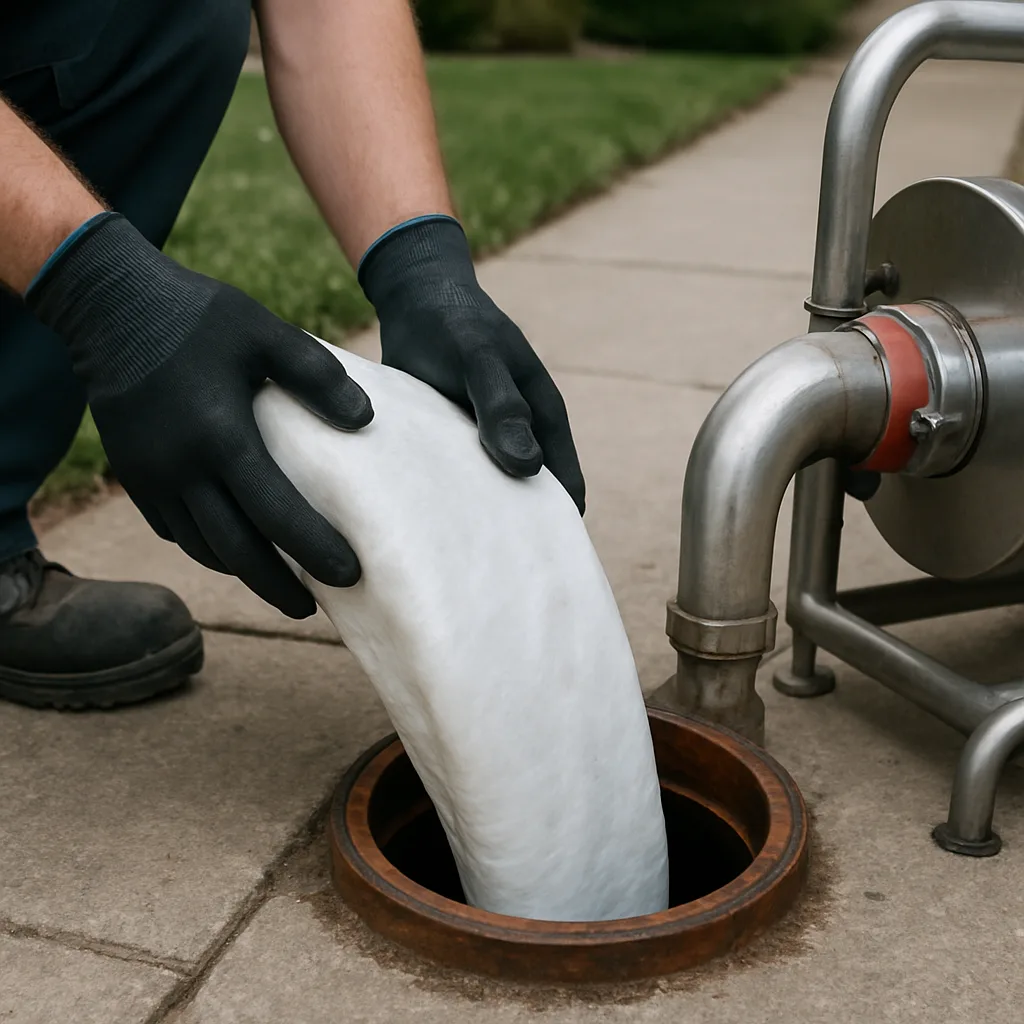
The saturated liner is loaded into an inversion drum and turned inside out down the lateral under air pressure, which presses the resin face directly against the host wall. Because the tube rolls onto the pipe instead of dragging along it, the resin face never scrapes and never picks up debris. A calibration tube then inflates inside the liner and holds it tight against the pipe until the cure sets.
Pull-in-place between two access points
Where the run has access at both ends, say a two-way cleanout at the house and a downstream pit, the liner is winched into position flat and then inflated. Pull-in-place suits short sections and point repairs where inverting the full run would waste material. It needs a genuinely clean invert, because the tube slides over whatever is left in the pipe.
Ambient, Steam and UV Cure
| Cure method | Typical cure window | Where it fits |
|---|---|---|
| Ambient | Several hours to overnight | Sectional repairs, warm ground, no schedule pressure |
| Hot water or steam | Roughly two to four hours | Full residential laterals, same-day return to service |
| UV with a glass fiber liner | Under an hour of light travel | Tight schedules, cold ground, highest material cost |
Ambient cure lets the resin harden at ground temperature: slowest, simplest, common on sectional work. Steam cure circulates hot vapor through the calibration tube and cuts the cure to hours, which is what makes same-day full-lateral work routine. UV liners swap felt for a glass fiber sleeve hardened by a light train drawn through the pipe at a controlled speed, the fastest cure at the highest material cost.
Cure is measured, not assumed. Thermocouples at the far end confirm the resin reached and held exotherm temperature along the whole run, and cool-down is staged so the liner does not shrink away from the wall. Diameter, length, ground temperature and resin system pick the method. A January lining in frozen Rockland ground is a different heat problem from the same job in August.
Diameter Loss, Branch Reinstatement and End Seals
A cured liner costs the lateral a fraction of an inch of bore, and the trade is favorable: the epoxy wall is far smoother than corroded iron or stepped clay joints, so flow capacity is preserved in practice.
Where a branch joins the run at a wye fitting or a lateral tap connection, the liner covers the opening during the cure. A robotic reinstatement cutter then travels the new pipe and mills each connection open from inside, on camera, with no digging over the fitting. Cut size and position come off the pre-lining survey, because a cutter that overshoots leaves an unsupported window in the new wall.
The liner ends decide whether the job actually stops infiltration. Both terminations are sealed so groundwater cannot track along the annular space between liner and host and reappear at the foundation, which is what turns a lined pipe into a closed system. Groundwater entering sewers through defects like these is the same infiltration the EPA’s NPDES program addresses at the municipal level, and a large share of it starts on private laterals.
How CIPP Liners Fail, and What Prevents It
Wrinkling and fins. The tube is oversized for the bore, or the host is oval, and the excess folds. A fin catches paper and starts the blockage cycle the liner was meant to end. Diameter selection off a measured survey prevents it.
Dry spots and delamination. Under-saturated felt cures soft, then separates from the host wall. Vacuum wet-out with thickness control at the roller prevents it.
Incomplete cure. Releasing pressure before the far end reaches temperature leaves a soft tail near the main. Thermocouple monitoring prevents it.
Missed reinstatements. A branch left covered is a backed-up basement fixture, and the closing camera pass exists to catch that before the crew leaves.
Trenchless Pipe Lining Cost in New City
| Work | Typical range |
|---|---|
| Sewer camera inspection | $250 to $500, often credited against the job |
| Sectional point repair, one defect | $1,500 to $4,000 |
| Full lateral CIPP lining | $4,000 to $12,000 |
| Pipe bursting, where lining is ruled out | $6,000 to $15,000 |
Length, diameter and the amount of cleaning the host needs decide where a job lands. Open-cut on the same line often runs 1.5 to 2x once excavation and landscape repair are counted, and that gap widens on the mature lots around Valley Cottage and Nanuet, where a trench would run under decades of driveway, patio and planting.
Frequently Asked Questions
How long does a cured-in-place liner last?
The liner is designed as a standalone structural pipe under ASTM F1216, with a service life measured in decades. Because it has no joints, the root intrusion that killed the original clay line has no way back in.
Will lining make my sewer pipe too narrow?
The cured wall takes up a fraction of an inch of bore. The epoxy surface is much smoother than scaled cast iron or misaligned clay sections, so in practice a lined lateral drains as well as it did when new.
Can a pipe with a belly be lined?
It can, but the liner follows the host pipe's shape, so the sag in the fall remains. A short belly is often lined anyway with eyes open; a long back-pitched run is usually better replaced by pipe bursting.
How much does trenchless pipe lining cost in Rockland County?
A full lateral lining typically runs $4,000 to $12,000 depending on length, diameter and how much cleaning the host pipe needs. A sectional point repair over one bad joint runs $1,500 to $4,000.
How long is the sewer out of service?
Plan for one working day. The line is down during cleaning, installation and cure, and back in use once the closing camera pass confirms the liner and the reopened branch connections.