New City Trenchless explains two-part epoxy resin systems, from brush-applied coatings to fully structural saturated tubes, for corroded cast iron and small-diameter branch drains. The trenchless pipe lining page covers the CIPP method itself. This page covers the material, because which resin goes into the pipe changes what the repair can do and where it can go.
Epoxy Is a Chemistry, Not a Method
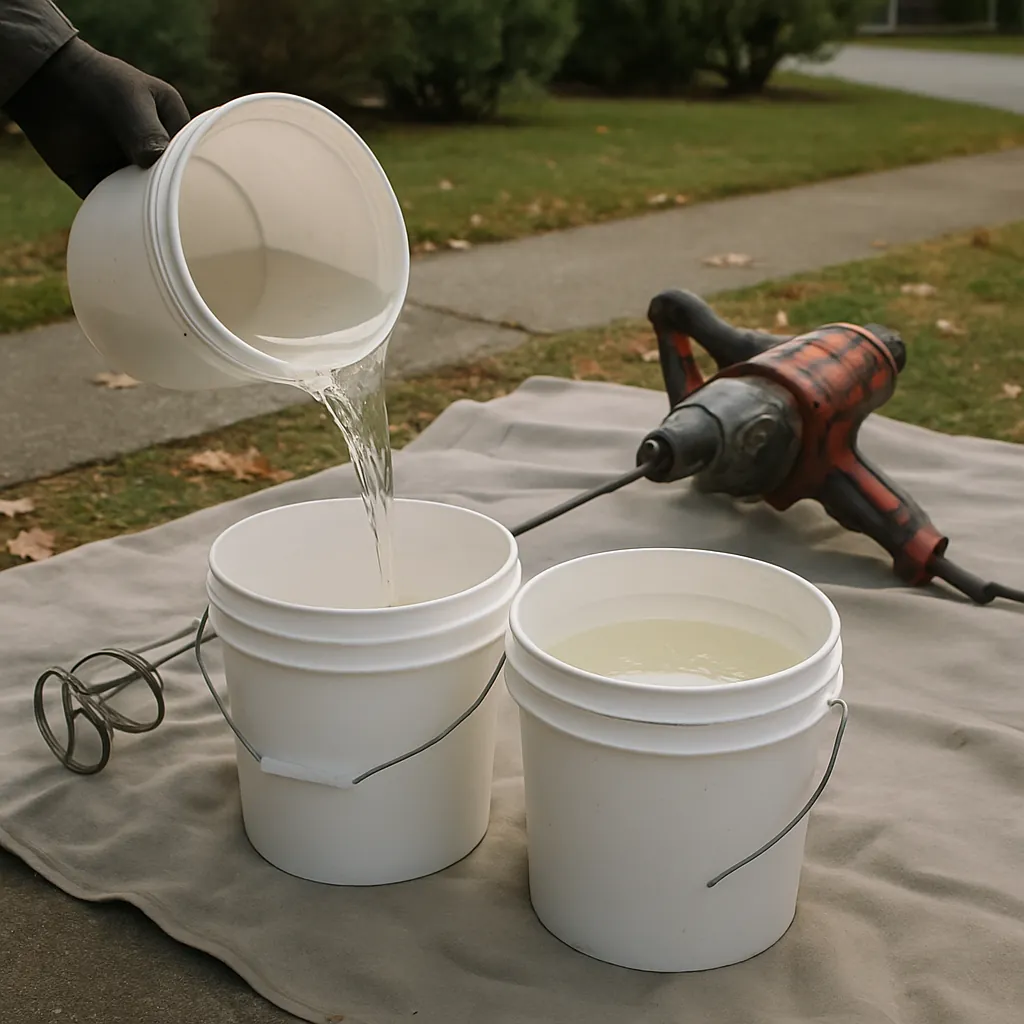
Epoxy is a thermoset: a resin and an amine hardener mixed on site in a fixed ratio, crosslinking into a rigid plastic permanently bonded to the host pipe. The ratio is not approximate. Off-ratio mixing leaves unreacted hardener in the film, and unreacted hardener means a soft, tacky surface that never reaches full hardness, so batches are weighed or metered rather than eyeballed.
Much of the lining industry runs on polyester or vinyl ester resins instead. They cost less, but they carry styrene and they shrink as they cure, and that shrinkage can pull a liner off the wall and leave an annular space for infiltration to track along the outside. Epoxy is styrene-free, so there is no chemical odor in an occupied house. Styrene is a monomer with recognized occupational exposure limits documented by NIOSH, and while a properly ventilated CIPP job is controlled work, avoiding the monomer entirely is a genuine advantage on a lining that runs through a finished basement.
Near-zero shrinkage keeps the new surface sealed against the old pipe from end to end. Epoxy also adheres to metal better than any competing resin family, which is exactly what a corroded cast iron drain needs.
Epoxy Against Polyester and Vinyl Ester
| Resin | Cure shrinkage | Styrene odor | Bond to cast iron | Relative cost |
|---|---|---|---|---|
| Epoxy | Very low | None | Strongest | Highest |
| Vinyl ester | Moderate | Yes | Good | Middle |
| Polyester | Highest | Yes | Weakest of the three | Lowest |
All three can be cured in place to ASTM F1216, the ASTM International standard for rehabilitation by an inverted and cured resin-impregnated tube. The standard governs the method and the design of the finished wall. It does not pick the chemistry for you. An occupied house, a metal host pipe and a run under finished space all push that choice toward epoxy.
Brush Coating or Structural Tube
Brush and spray applied coatings
A thin epoxy film built up over a cleaned, descaled bore in several passes, each one allowed to reach a tack state before the next goes on so the layers bond chemically into a single film instead of stacking as separate skins. Spray-in-place pipe lining and brush coating stop internal corrosion and smooth the wall, but they add no strength. This is the right answer when the iron still has sound wall thickness and the actual problem is roughness, scale buildup and recurring grease blockage.
Structural epoxy tubes
A felt liner tube or fiberglass sleeve saturated with epoxy and cured in place to ASTM F1216. This builds a self-supporting pipe within the pipe that keeps working even as the old iron continues rusting around it. Wall thickness is engineered against depth of cover, soil load and groundwater head rather than picked off a shelf. This is the right answer when the camera shows cracks, channeling or real wall loss.
The CCTV footage makes the choice between them, not a sales script, and defects get coded to the PACP standard from NASSCO so the record states exactly what was found and at what distance.
Descaling Cast Iron Is Most of the Work
Cast iron does not fail evenly. It corrodes from the inside into hard nodules, a process called tuberculation, and those nodules choke the bore while the flow cuts a groove along the invert. A coating applied over tubercles bonds to rust, and rust bonds to nothing.
Descaling runs in stages. A chain knocker or flail on a flexible shaft breaks the nodules loose. A rotary descaling head follows and takes the wall back toward bare metal. Hydro jetting flushes the debris out so it does not resettle in the invert. Then the pipe is dried, usually with forced warm air, because epoxy will not bond to a damp wall. A camera pass confirms bare metal end to end before any resin is mixed.
If descaling starts opening holes, the wall was already too far gone and the line was never a coating candidate. That job becomes structural cast iron pipe lining with a full tube, or replacement.
Small Diameter Branch Lines Are Epoxy Territory
The 1.5 and 2 inch kitchen, bathroom and laundry branches in mid-century Rockland homes are too small to burst and too buried in walls and slabs to replace without demolition. Epoxy reaches them through existing cleanouts and roof vent stacks.
Galvanized and cast iron branches from the 1950s and 60s choke down with scale and soap deposits decades before they actually break. Descaling followed by an epoxy coat restores the bore without opening a single wall. In the older housing in Nyack and up in Suffern, those branches are often original, run inside plaster walls, and sit above finished ceilings that would cost more to rebuild than the drain repair itself. That ratio, repair cost against demolition cost, is what makes small-diameter epoxy work worth doing at all.
Where a structural tube crosses a wye fitting or a lateral tap connection, a robotic reinstatement cutter reopens the branch from inside the new pipe, on camera, so nothing is left blind.
Pot Life, Cure Windows and Why Prep Decides the Job
Mixed epoxy has a pot life, a fixed working window before the exotherm takes over and the batch hardens in the bucket, so saturation and installation are planned backward from that clock. Temperature drives it in both directions. Ambient cure stretches out in a cold January crawl space and shortens in August heat, and a warm mix going into a warm pipe can go off faster than the crew can place it. Steam cure compresses the window deliberately when the schedule demands it.
The failure mode of a bad epoxy job is delamination, because the resin will not bond to a wet, greasy or scale-covered wall. That makes surface preparation the real work: mechanical descaling, jetting and drying before any resin enters the pipe. On the low-lying western side of the county around the Hackensack headwaters, where groundwater keeps buried host pipes damp year round, that drying step is the difference between a lining that lasts decades and one that peels inside a year.
Where Epoxy Is Not the Right Call
Deformed Orangeburg. Coating an oval pipe preserves the oval, and a structural tube cannot press against a wall that has folded inward. Those runs go to pipe bursting.
Heavy wall loss. Once descaling would perforate the host, a coating has nothing to hold onto and the repair has to be a full structural tube or a replacement.
Bellies and back-pitch. Epoxy follows the host pipe exactly, so standing water stays standing and the sag is still there when the resin hardens.
Potable water lines. Any epoxy in contact with drinking water has to be certified to NSF/ANSI 61 by a body such as NSF. That is a different product, a different applicator scope and a different conversation from drain work.
Epoxy Pipe Lining Cost in New City
| Work | Typical range |
|---|---|
| Camera inspection | $250 to $500, often credited against the work |
| Sectional epoxy sleeve, one defect | $1,500 to $4,000 |
| Structural lining, full lateral | $4,000 to $12,000 |
| Open-cut replacement of the same line | Often 1.5 to 2x the trenchless price |
Structural lining of a full lateral falls in the same $4,000 to $12,000 range as any cured-in-place job, with epoxy sitting at the upper part of that range for a given length because the resin costs more per gallon. A sectional epoxy sleeve over one defect runs $1,500 to $4,000. Small-branch coating is priced by the fixture run after the camera inspection, since the length, the number of fittings and how much descaling the iron needs are what actually vary from house to house.
Frequently Asked Questions
Is epoxy pipe lining structural?
It can be either. A brush or spray applied epoxy coating is a corrosion barrier only, while a felt or fiberglass tube saturated with epoxy and cured in place is a structural liner rated to stand on its own under ASTM F1216.
What is the difference between epoxy lining and CIPP?
CIPP is the method, epoxy is one resin used in it. Many CIPP jobs use polyester resins that carry styrene and shrink slightly as they cure; epoxy is odor-free, shrinks almost none and bonds better to cast iron, at a somewhat higher price.
Can you line 2 inch drain lines with epoxy?
Yes. Small kitchen and bath branches are reached through cleanouts and vent stacks and coated after descaling, which is usually the only trenchless option at that diameter.
How much does epoxy pipe lining cost in New City?
A full lateral runs $4,000 to $12,000 like other cured-in-place work, a sectional sleeve $1,500 to $4,000, and small-branch coating is quoted per run after a $250 to $500 camera inspection.
How soon can the drain be used after the epoxy goes in?
That depends on the cure method rather than the resin. An ambient cure on a branch line can run overnight, while a steam cure on a full lateral is usually measured in hours. The drain goes back into service after the closing camera pass confirms a hard, continuous film and open branch connections.