New City Trenchless explains commercial sewer repair across Rockland County in the 6 and 8 inch laterals found at restaurants, retail plazas and multi-tenant buildings. These projects can be scheduled around business hours rather than forcing a daytime shutdown.
Repair That Does Not Close the Business
Everything about trenchless staging favors an operating property. The work happens at cleanouts and small access points, not in a trench across the entrance, and the loudest phase is the cleaning. A liner installed in the evening reaches full cure overnight, so the doors open on time with a structurally new pipe under the building. For a restaurant, that is the difference between a repair and a closure.
The alternative is worth pricing honestly. Open-cut across an active parking lot means saw-cut asphalt, a shored trench that has to meet OSHA excavation rules for protective systems, plated overnight closures, then base repair and paving weeks later. Lost parking and lost trading days are usually the largest line on that invoice and they never appear on the quote.
Larger Diameters Are a Different Engineering Problem
Commercial pipe is not residential pipe scaled up. Liner wall thickness is a design calculation under ASTM F1216 that grows with diameter, burial depth, groundwater load and whether the host pipe is treated as partially deteriorated or fully deteriorated. The liner in an 8 inch run under a loading dock is engineered for that case, not picked off a shelf.
At these sizes a fiberglass liner or UV-cured liner carries more structural stiffness per millimeter of wall than a standard felt tube, and steam cure brings a long large-diameter run to full strength inside a working window that ambient cure cannot meet. For long straight runs where some diameter loss is acceptable, slip lining a new pipe inside the old one and grouting the annular space is the economical answer. For collapsed sections, bursting in HDPE restores full bore.
| Condition found | Method | Diameter effect |
|---|---|---|
| Scaled or cracked host, shape intact | CIPP lining, felt or fiberglass | Fraction of an inch lost, smoother bore |
| Long straight run, capacity to spare | Slip lining with grouted annulus | One nominal size down, typically |
| Collapsed or badly deformed run | Pipe bursting in HDPE | Same size or upsized |
| One failed joint at a tenant tap | Sectional point repair | Local only |
Either way, a robotic reinstatement cutter reopens every tenant connection from inside the new pipe, which is what keeps a multi-tenant building flowing the morning after.
Cleaning Is Half the Commercial Job
A liner bonds to what it is pressed against. If that is a quarter inch of hardened grease or a rind of tuberculated scale, the liner is bonded to something that will later let go, so cleaning is not preparation for the work, it is a large share of the work.
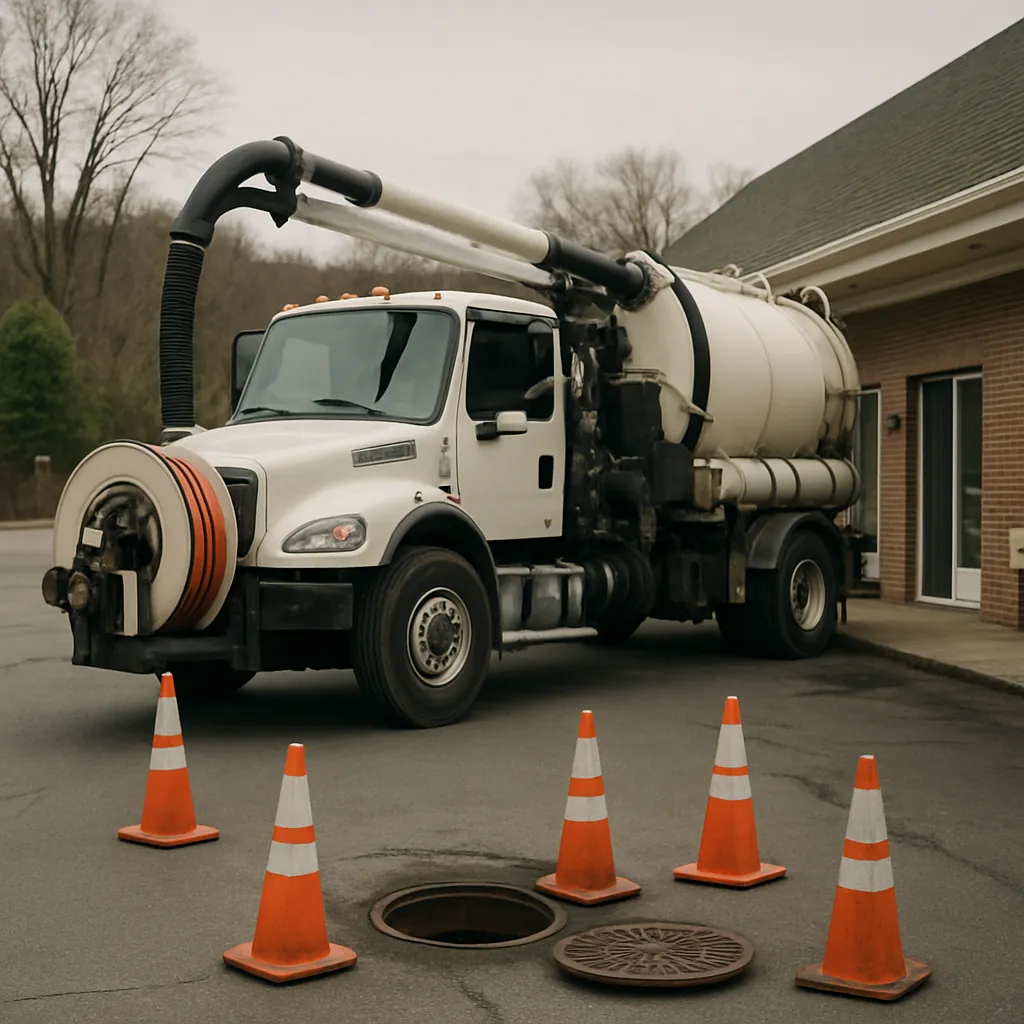
Commercial cleaning runs at higher flow than residential. A truck-mounted hydro jetting unit working an 8 inch line needs volume to carry debris back to the access point, not just pressure to cut it, and nozzle choice changes with the target: a penetrator to open a plug, a rotating nozzle to strip grease off the wall, a chain flail or descaling head to take mineral scale and root remnants off cast iron down to bare metal. A camera pass after cleaning confirms bare wall before any resin is wet out.
Restaurant Lines: Grease Is a Schedule, Not a Surprise
A grease blockage in a kitchen lateral is not bad luck. Grease recoats the pipe wall at a rate set by the menu, the dish pit water temperature and how well the interceptor is maintained, which means the next blockage has a date even if nobody knows it yet.
Fats, oils and grease leave the dish sink as a warm liquid and solidify as the wastewater cools along the run, which is why the buildup is usually thickest thirty to sixty feet out rather than at the fixture. Interceptors exist to catch that before it reaches the public system, and grease is a recognized cause of sanitary sewer overflows in the EPA’s wastewater discharge program. Undersized or unpumped interceptors move the problem from your lateral to the main, which is where it stops being only your bill.
A jetter on a planned interval keeps ahead of that date, and a camera pass after jetting shows whether the wall came back to bare pipe. Lining changes the maintenance math too: a cured epoxy bore is far smoother than scaled cast iron, so grease has less to key onto. It does not remove the need for interceptor service, and owners should be told that plainly.
Bypass and Flow Control While the Liner Cures
A house can go without its drain for a day. A twelve-unit building or a plaza with three food tenants cannot, so flow gets managed rather than stopped. On short runs that means scheduling the outage into closed hours and confirming in writing which hours the drains are down.
On longer runs, or where a tenant genuinely cannot stop discharging, a bypass pump moves flow from an upstream manhole or cleanout around the section being lined and returns it downstream, so the pipe is dry while it cures and the building keeps operating. Plugs and pumps are sized to the peak flow the building actually produces, which for a restaurant is the two hours after service, not an average.
What Property Managers Get on Paper
Commercial sewer decisions are made by people who answer to owners and tenants, so the paperwork matters as much as the pipe. Ask for a sewer camera inspection report coded to NASSCO’s PACP standard, with every defect logged by severity and footage marker.
That coding supports capital planning, insurance files and cost allocation across tenants, because a report that says “grade 4 fracture at 62 feet” survives a dispute in a way that “pipe looks bad” does not. Where a lateral crosses a neighboring parcel, the run should be documented against the recorded easement before work starts. Request post-repair video of the finished line.
Rockland’s Commercial Building Stock and What Sits Under It
The plaza retail along the Route 59 corridor through Nanuet and Spring Valley went up in the same postwar decades as the housing around it, which means the same materials. Cast iron under the building slab, clay tile out to the tap, and in the oldest strips, sections of Orangeburg from the plant ten miles down the road in Orangeburg NY.
That building stock has since been re-tenanted several times, and a unit that started as a dry goods store and is now a kitchen is discharging loads its lateral was never sized or specified for. It also means the as-builts are frequently wrong, so locating and mapping should come before a firm quote. On low-lying sites near the Hackensack headwaters, high groundwater adds an external load case to the liner design and shows up as infiltration on camera, which is a reason to line the whole run rather than patch one joint.
Pricing and Scheduling for Commercial Work
Commercial jobs are priced from four inputs: pipe diameter, footage, access conditions and cure method. The residential ranges published on this site, $4,000 to $12,000 for full trenchless pipe lining and $6,000 to $15,000 for pipe bursting, act as the floor. Larger diameters, longer runs, bypass pumping and overnight windows price above them, and open-cut comparison work still lands at roughly 1.5 to 2x the trenchless number once paving and downtime are counted.
The sequence is always survey first, number second, and the schedule is written around your operating hours, not around daylight.
Frequently Asked Questions
Can you reline a sewer under a parking lot without closing it?
Yes. Lining works from the ends of the pipe, so the staging footprint is a cleanout or a small access pit with cones around it, not a trench across the lot. Customer parking and the entrance stay open while the liner cures below.
Do you work overnight or on weekends?
Yes. Installing in the evening and curing overnight can put the line back in service before the first shift or seating, which is the point of choosing trenchless for an occupied business.
How often should a restaurant have its sewer line jetted?
Somewhere between quarterly and annually for many kitchens, but the honest answer is set by the camera, not the calendar. The cleaned wall should be inspected after jetting and the interval set from evidence.
What does commercial sewer repair cost?
It is priced by diameter, footage, access and cure method rather than a flat menu. The residential ranges published on this site, $4,000 to $12,000 for lining and $6,000 to $15,000 for bursting, are the floor for commercial work, and a firm number follows the camera survey rather than preceding it.
Do the tenants have to stop using the drains while you work?
Only during the install and cure window when no bypass is running. A provider can schedule the outage for closed hours or pump around the section being lined, with written notice of the exact drain outage window.