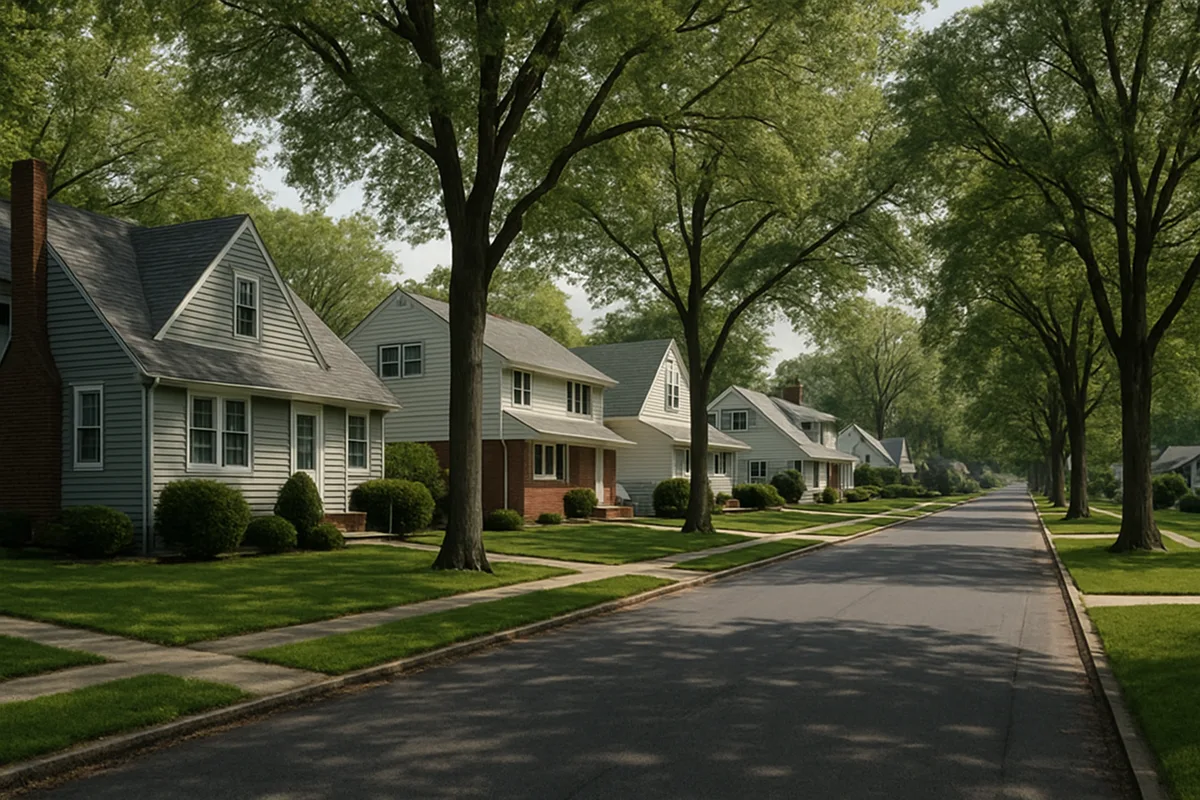
New City Trenchless covers lining and replacement options for sewer laterals in Suffern, the village at the Ramapo Pass where vitrified clay and cast iron have served older housing for decades. The combination of historic housing and nearby groundwater makes camera-guided method selection especially important.
Erie Railroad Housing on a Narrow Valley Floor
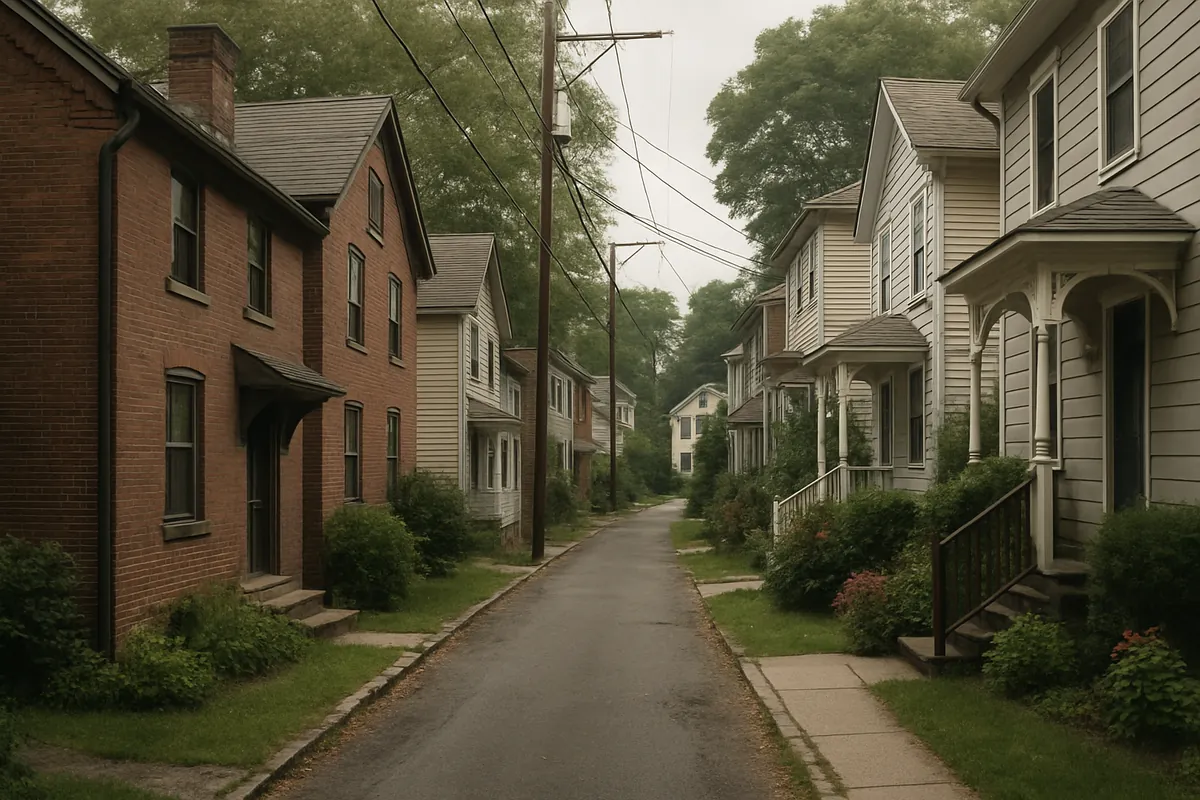
The village grew up along the Erie main line from the 1840s and incorporated in 1896, and the blocks off Lafayette Avenue still hold housing from the 1880s through the 1920s. Suffern was a working railroad town with yards and shops, which meant workers’ housing built close together on small lots, and that pattern is still the street grid today.
A lateral from that era is one of two things. It is clay tile laid in short sections with a mortared joint every few feet, or it is cast iron that has spent a century losing its invert to channeling. Neither material was expected to serve this long, and in most cases neither has been touched since the day it was buried.
Small lots produce the second half of the problem. Laterals here run under porches, front steps, driveway aprons and, on the oldest blocks, under work that was added over the pipe decades after the pipe went in. Open cut on a lot like that does not just cost 1.5x to 2x the trenchless price. It can mean taking apart something that will never go back the way it was.
The Ramapo Rises and the Water Table Comes Up With It
The Ramapo River runs right past the village through the Ramapo Pass, and the valley floor holds a high water table. That single fact drives most Suffern sewer diagnostics.
When the river runs high, groundwater rises into the same soil zone the laterals sit in. Every open joint, hairline crack and offset below that line becomes an inlet. This is infiltration: clean groundwater entering a pipe whose only job is to carry sewage out. At first it produces no smell and no mess. It produces a line that is suddenly at capacity because most of what it is carrying has nothing to do with the house.
Suffern has taken serious river flooding more than once, and the FEMA Flood Map Service Center shows how much of the village sits inside mapped floodplain. USGS water data for the Ramapo gauges gives the river’s actual behavior rather than anyone’s memory of it. If your drains misbehave in wet weather and behave perfectly in dry weather, that correlation is most of the diagnosis already.
Wet Weather and Dry Weather Tell Different Stories
| Symptom pattern | Most likely cause | What the camera looks for |
|---|---|---|
| Backs up during or after heavy rain and river highs | Groundwater infiltration through joints and cracks | Weeping joints, water running in a line with no fixtures in use |
| Backs up on a schedule regardless of weather | Root intrusion or grease and scale buildup | Root masses at joints, wall deposits narrowing the bore |
| Slow drains that never fully clear | A belly, an offset, or heavy cast iron channeling | Standing water in the run, loss of invert |
| Sudden total stoppage with no warning | Collapse or a foreign obstruction | Loss of camera passage at a fixed distance |
That table is why we scope before quoting. The four patterns look similar from inside the house and lead to four different jobs.
A Village That Pays for Every Gallon It Treats
Suffern operates its own wastewater treatment plant beside the Ramapo through its Department of Public Works rather than pumping flow to a county facility, and that plant sits in the floodplain. It was knocked out when Hurricane Irene pushed the river over its banks in 2011.
The economics follow directly. Every gallon of groundwater leaking into a private lateral arrives at a plant the village itself pays to run, and a permitted plant is held to its discharge limits whether the flow arriving is sewage or river water. In Sewer District No. 1 towns the cost of infiltration disappears into a county budget. In Suffern it stays local. A tight lateral is worth more here than almost anywhere else in Rockland County.
Lining an 1890s Lateral Without Opening Lafayette Avenue
A CCTV inspection with a locating sonde maps the run, its material and its depth first, with defects coded to PACP standards rather than described from memory. A hydro jetter then strips roots and scale back to bare pipe wall. An epoxy-saturated felt liner goes in through the cleanout on an inversion drum, a calibration tube presses it tight against the host pipe, and it cures into a jointless cured-in-place pipe built to ASTM F1216.
Trenchless pipe lining closes every joint in the run at once, which is precisely what an infiltrating clay lateral needs. Sealing one joint on a hundred-year-old line just moves the water to the next one. Where the camera finds a single failed joint in an otherwise tight line, a sectional point repair covers that joint alone at $1,500 to $4,000 and leaves the rest untouched.
Cast Iron, Clay, and the Lines That Cannot Be Lined
Suffern has far more cast iron than the postwar towns east of here, because cast iron was standard when these blocks were plumbed rather than a stub under the slab. It fails from the inside out. The invert channels away, tuberculation builds up on the walls and narrows the bore, and the section closest to the house often goes first. Cast iron pipe lining works well on it as long as the pipe still holds its shape and enough wall to bond to.
Two conditions rule lining out entirely. A clay section that has crushed or gone badly offset leaves no host pipe to line against. Cast iron that has channeled through its wall has nothing left to bond to. Both go to pipe bursting, which replaces the run outright with fused HDPE that gives roots and groundwater no joints to find, working from two pits instead of a trench up the front walk. A sewer camera inspection at $250 to $500 makes that call before any price is final.
What Suffern Work Costs and Why Prep Runs Longer Here
The camera inspection is $250 to $500 and is usually credited toward the repair. Sectional spot repairs run $1,500 to $4,000. Lining a full lateral runs $4,000 to $12,000 depending on length, depth and how much preparation the host pipe needs. Pipe bursting runs $6,000 to $15,000.
Century-old lines under the village’s mature street trees may need more root cutting before a liner can go in, and the behavior of tree roots around buried utilities is covered by Cornell Cooperative Extension. That can affect labor and the final quote. Considerably younger pipe appears in Airmont next door and Monsey to the east.
Frequently Asked Questions
Does river flooding in Suffern affect private sewer lines?
Yes. When the Ramapo runs high the water table rises with it, and every crack or offset joint in a lateral lets groundwater pour in. Drains that gurgle or back up in wet weather but behave in dry weather are the classic sign of infiltration, and a camera inspection confirms it.
Can a century-old clay or cast iron lateral be lined?
Usually. Both materials make a sound host pipe as long as they still hold their shape. Heavily channeled cast iron or a crushed clay section may need a spot repair or pipe bursting instead, and the camera decides that before any price is final.
How much does trenchless sewer repair cost in Suffern?
Typical planning ranges are $1,500 to $4,000 for a sectional spot repair, $4,000 to $12,000 to line a full lateral, and $250 to $500 for the camera inspection that scopes the job. Site conditions determine the actual quote.
Will lining actually stop groundwater from entering my line?
That is the main thing it does. The cured liner is one continuous pipe with no joints, so there is nowhere left for groundwater to enter or roots to follow. On a village system that treats its own flow, that matters beyond your own basement.
Should I add a backwater valve if my basement has flooded before?
It is worth discussing on low-lying village properties, but it treats a symptom. If the camera shows the lateral is taking on groundwater through open joints, sealing the pipe is the fix that removes the load, and a valve is a second line of defense rather than the repair.