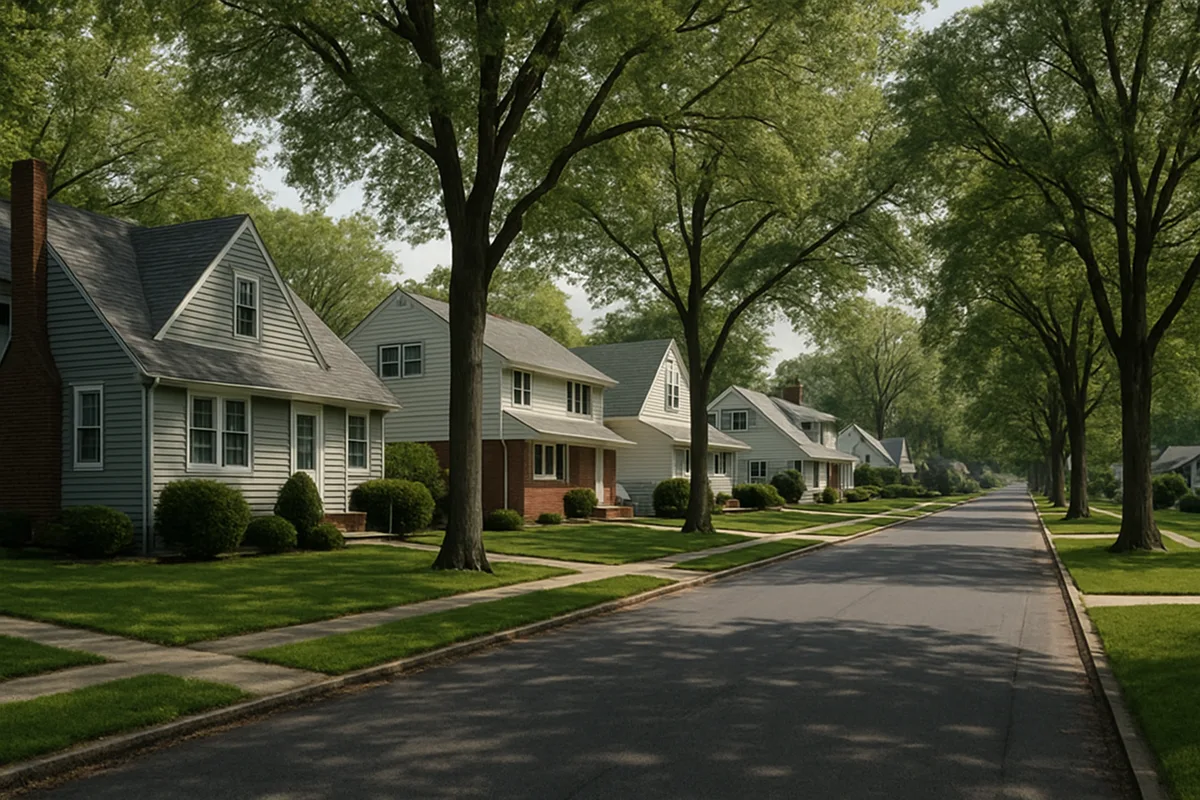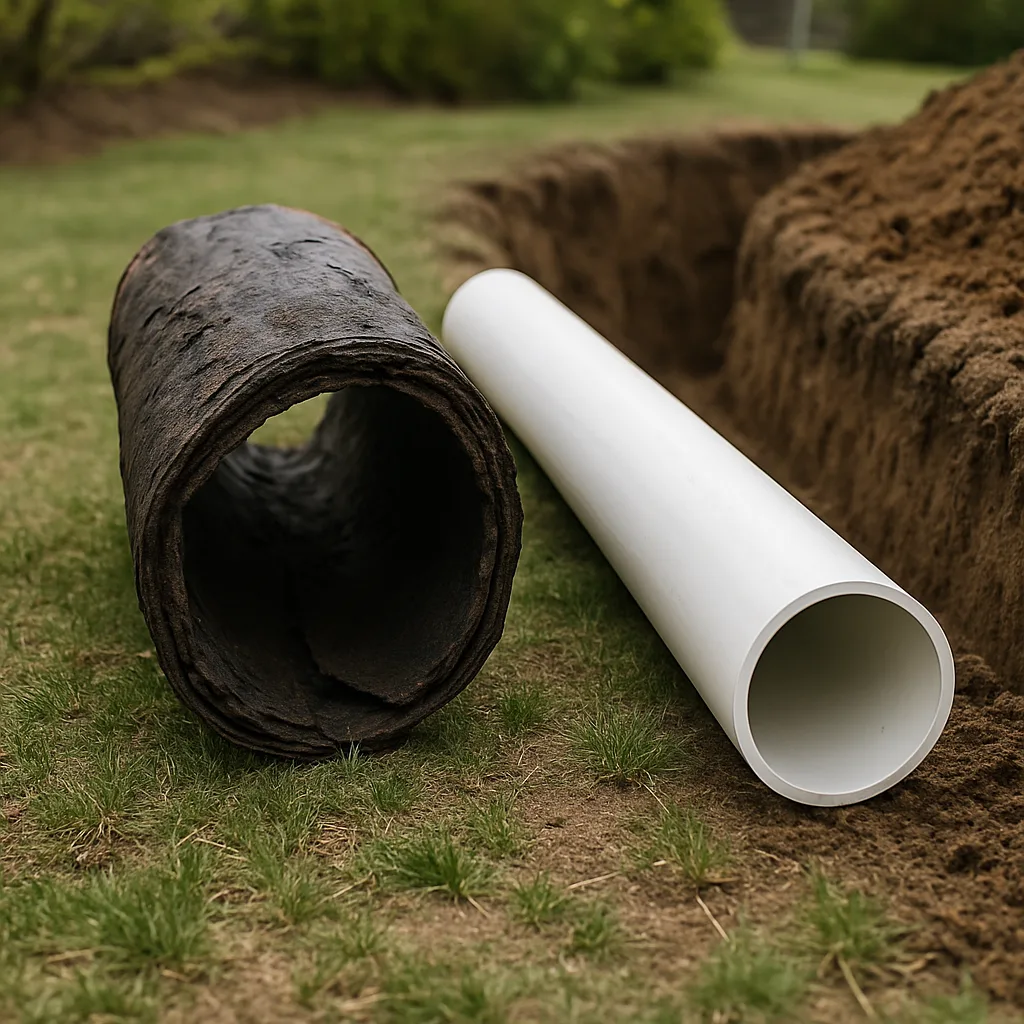
New City Trenchless explains replacement options for Orangeburg pipe, the bituminized fiber sewer conduit manufactured ten miles from New City and buried under Rockland County lawns throughout the postwar building boom. Houses built between 1945 and 1972 anywhere in this county may still drain through it, and much of the surviving material is now beyond its expected service range. Pipe bursting is often the suitable replacement method, and this page explains why.
How to Tell If Your Lateral Is Orangeburg
Building records rarely name the pipe material, so the build year is the first filter and a CCTV sewer inspection is the only certain answer. On camera, Orangeburg shows a matte black wall, long jointless runs between tapered fiber couplings, and usually some degree of egg-shaped bore. Above ground the tells are backups that return weeks after snaking, a settling stripe or damp band in the lawn along the pipe path, and a drain auger that comes back with black fibrous material on the head, which is the pipe itself, not a clog. The inspection runs $250 to $500 and is often credited against the repair, and a locating sonde marks line, depth and the future pit positions during the same visit.
Fiber conduit was cut and coupled on site, so a run that turns under a patio usually has a coupling at the bend, and that coupling is where the picture degrades first. Every defect is logged against the NASSCO Pipeline Assessment Certification Program codes, so the footage reads the same to you as to anyone reviewing the job later.
What Deformation Grade Rules Out
Orangeburg is graded on shape before it is graded on holes. The moment the bore stops being round, the rehabilitation options start falling away, because every trenchless repair except bursting needs the old pipe to work as a mold.
| What the camera shows | What it means | Practical option |
|---|---|---|
| Round bore, sound wall, root at one coupling | Unusual on 50 year old fiber | Spot repair buys time, replacement still planned |
| Light ovalling, surface blistering | The wall is absorbing water and softening | Bursting, because a liner would lock in the lost bore |
| Clear egg shape, delaminated flaps in the flow | Structural loss along the run | Bursting |
| Camera cannot pass, standing water upstream | Collapse | Bursting, with a short excavation at the collapse if the head cannot be launched through it |
How Orangeburg Fails: Ovalling, Blistering and Torn Walls
Orangeburg is layered wood fiber saturated with coal tar pitch. Its selling point was having no joint to leak every few feet, but the wall itself is the weakness. Under decades of soil load the round bore squeezes into an oval, top down, and that flattening steals capacity before anything visibly breaks. Moisture wicks into the fiber layers, which delaminate and blister inward until loose flaps hang in the flow and catch everything that passes. Roots enter through seams and couplings. Snaking makes all of this worse: the auger head tears the softened wall open, which is why the same blockage keeps returning faster each time. The end state is a collapsed pipe, most often under the driveway where loads run highest.
A second failure never shows as a backup at all. A softened fiber wall leaks both directions: sewage exfiltrates into the soil, feeding the darker green stripe in an otherwise even lawn, and groundwater infiltrates back in during wet weather. Aging private laterals are part of the national wastewater picture tracked in the ASCE Infrastructure Report Card, and here that problem has one dominant material.
Why Lining Rarely Rescues Deformed Orangeburg
Cured-in-place lining needs a host pipe that still holds a continuous, roughly round shape to act as a mold. Deformed Orangeburg fails that test twice over. A liner cured inside an ovalled bore permanently locks in the reduced cross-section, and a blistered fiber wall cannot be cleaned back to a sound surface for resin to follow, because hydro jetter pressures that routinely descale clay or iron will blow straight through softened fiber. A sectional point repair hits the same wall at smaller scale. When the camera shows real deformation, rehabilitation is off the table, which is the opposite of the call on clay and cast iron, where lining is often exactly right.
Pipe Bursting: The Standard Orangeburg Fix
Pipe bursting could have been designed for this material. A conical bursting head is winched through the old run, splitting the soft fiber outward into the soil while towing new HDPE pipe of equal or larger diameter directly behind it. Static bursting pulls the head with a rod string from the exit pit, which suits shallow residential laterals near foundations because it is a steady pull rather than a percussive hammer.
The new pipe is high density polyethylene, joined by butt fusion under the practice set out in ASTM F2620, where the pipe ends are heated on a plate and pressed together to form a joint as strong as the pipe wall itself. That matters more here than the pulling rig does. A fused HDPE lateral has no hub, no bell and no gasket anywhere along its length, so the root intrusion that killed the fiber couplings has nothing to enter through.
Day of work, the sequence is short. Two pits go in, one at the house or an existing cleanout and one at the tap, sized for the depth of the pipe rather than the length of the run. The new HDPE is fused into a single string, then follows the expander through in one continuous pull. Tie-ins, a two-way cleanout and any needed backwater valve complete the work. Many residential pulls take one to two days, subject to access and permit conditions.
Driveways, Frost Depth and Where the Line Gives First
Rockland laterals sit several feet down, deep enough to stay under frost, which is why open-cut on these lots means a deep trench rather than a shallow one. The depth is also why the driveway section fails first on so many of these houses. Vehicle loads concentrate on the pipe crown, freeze-thaw cycling works the soil above it every winter, and fiber conduit that is already softening ovals fastest exactly where it is least convenient to dig.
The tract houses of Bardonia and the ring around it were built fast and landscaped since, so the pipe path now runs under a paved apron, a mature maple, a patio slab or all three. Bursting reads the old bore as its guide and leaves everything above it alone.
Orangeburg Pipe Replacement Cost in New City
Bursting out a failed Orangeburg lateral runs $6,000 to $15,000, driven by run length, depth and how much room the pits have. Open-cut replacement of the same line typically lands at 1.5 to 2x once excavation, hauling and landscape repair are counted, which is why trenchless wins on most Rockland lots with mature trees, a driveway or hardscape over the pipe path. The camera inspection prices the job before any commitment. Work that reaches into the public right of way is coordinated with the town or village and with Rockland County on the district side, since the main itself is not yours to touch.
The Factory Ten Miles Away
The pipe is named for Orangeburg, NY, where the Fibre Conduit Company manufactured bituminized fiber pipe through the postwar building boom. Wartime and postwar iron shortages made cheap fiber conduit common in new subdivisions, including Rockland’s capes, ranches and split-levels. Production ended in the early 1970s as PVC took the market. A camera inspection, not the home’s date alone, should confirm the material.
Frequently Asked Questions
How do I know if my house has Orangeburg pipe?
The build year is the first clue: Rockland homes built between 1945 and 1972 are in the install window. A $250 to $500 camera inspection settles it, and the fee is often credited against any repair.
How much does Orangeburg pipe replacement cost in New City?
Pipe bursting replacement runs $6,000 to $15,000 depending on length, depth and pit access. Open-cut replacement of the same line is often 1.5 to 2x once excavation and landscape repair are counted.
Can Orangeburg pipe be lined instead of replaced?
Rarely. Once the bore has deformed, a liner locks in the reduced shape, and the blistered fiber wall cannot be cleaned enough for resin to bond. Bursting in new HDPE is the standard fix.
How long does Orangeburg pipe last?
About 50 years under good conditions, less under driveways and heavy soil loads. Rockland installations date from 1945 to 1972, so surviving lines are all past 50 and many past 70.
Is snaking a safe fix for an Orangeburg backup?
No. An auger tears the softened fiber wall, which is why the backups return faster each time. If the camera confirms Orangeburg, put the money toward replacement, not repeat cleanings.
Does the new pipe have to be the same diameter as the old one?
No. Bursting can hold the existing size or upsize it, because the head displaces soil rather than following a fixed bore. Most residential laterals here go back in at four inches, which is the standard size for a single-family house drain.