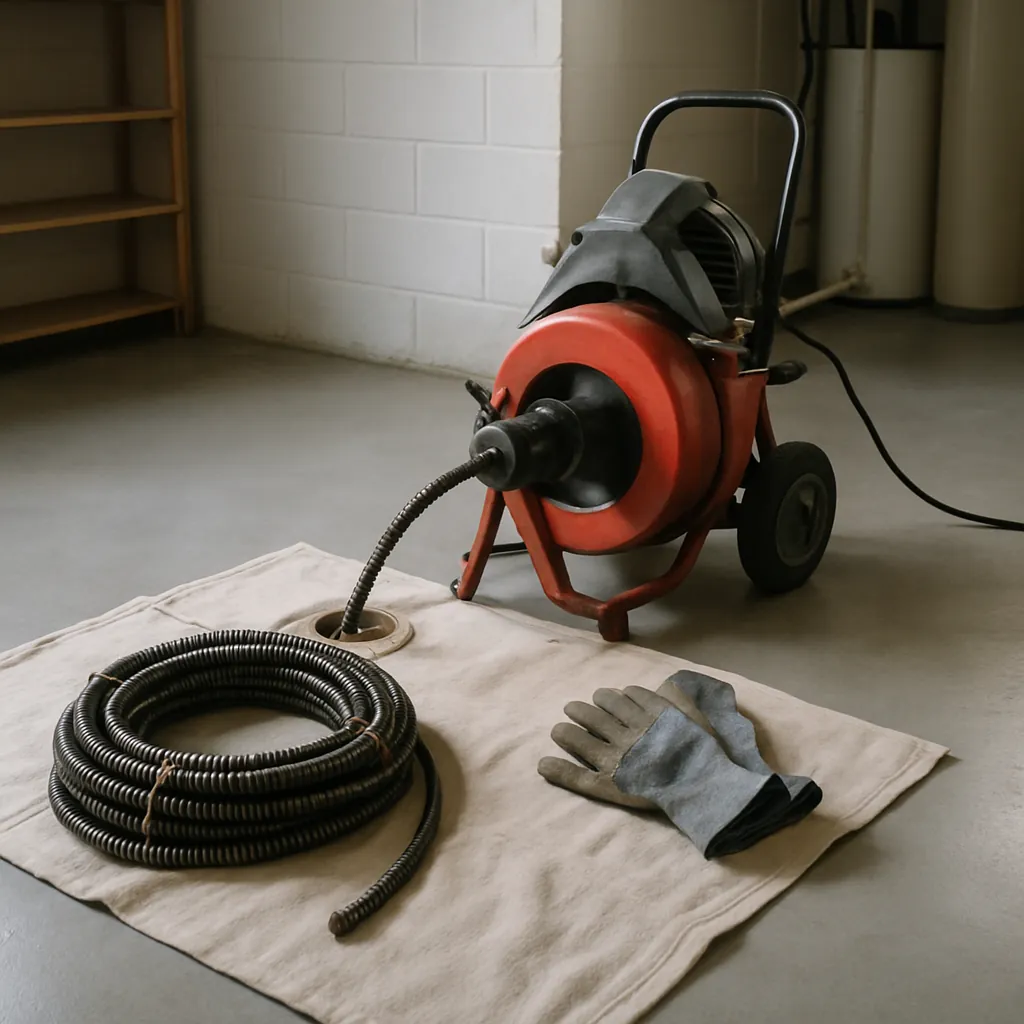
New City Trenchless explains how blocked drains across Rockland County are cleared with drain augers or hydro jetting, and why a lateral that has blocked twice should be inspected by camera. A second backup often means the pipe has a defect, not just a clog. Matching the machine to the blockage is most of drain cleaning; the rest is knowing when cleaning has stopped being the answer.
Cable or Jet: Matching the Tool to the Blockage
Cabling and augering
A drain auger drives a rotating cable with a cutting or retrieval head through the blockage. It is the right call for a single soft obstruction: a paper clog, a wad of wipes, an object that went down a toilet. Working through an existing cleanout, it opens the line fast and cheap. What it does not do is clean the pipe wall. A cable bores a hole through the problem and leaves the rest of it in place.
Jetting
The hydro jetter cleans the full circumference of the pipe with high pressure water, which makes it the tool for grease, sludge and scale rather than for a one-off clog. Where a cable punches through a grease wall that closes behind it, jetting strips the wall off the pipe and flushes it to the sewer main. The full treatment is on our hydro jetting page.
Cable Diameter, Head Choice and Why They Are Not Interchangeable
Cable is sized to pipe diameter and the head is chosen for what the blockage is made of. The wrong combination either never reaches the blockage or damages the pipe.
| Line | Typical cable | Usual head |
|---|---|---|
| Lavatory and sink arms, 1.25 to 1.5 inch | 1/4 to 5/16 inch | Bulb or drop head |
| Tub, shower and kitchen branches, 1.5 to 2 inch | 5/16 to 3/8 inch | Bulb head, retrieving auger |
| Branch and stack lines, 3 inch | 1/2 inch | Retrieving auger, small C-cutter |
| Main lateral, 4 to 6 inch | 5/8 to 3/4 inch | C-cutter, expanding blade, root saw |
A sectional machine gives more torque at the head and is what a long 4 inch lateral usually wants. A drum machine sets up faster and is easier on finished basements. The classic failure mode is an undersized cable sent down a 4 inch main: it whips inside the larger pipe, tunnels through the soft center of the blockage, and reports success while the wall stays coated.
Which Drain Is Blocked Changes the Job
Kitchen lines
Almost always grease blockage, built up in layers over years, and worst where a 1.5 inch arm turns into a 2 inch branch and flow slows. Cabling gives weeks of relief. Jetting resets the line.
Bathroom groups
Hair, paper and soap load, and occasionally a venting problem masquerading as a clog. If more than one fixture gurgles when the tub drains, the problem is downstream of all of them, or air is not getting into the system through the vent stack. A drain that glugs and empties slowly with no blockage on the cable is a vent question, not a cleaning question.
The main lateral
When every drain in the house backs up at once, the blockage is in the lateral. The usual Rockland suspects are root intrusion at clay joints, a bellied section holding solids, an offset joint snagging paper, and in the older village homes, a buried house trap collecting everything the line sends it. Repeat main line backups belong on our sewer backup repair page, because at that point the pipe, not the household, is the cause.
Slope, Bellies and the Lines That Refill
Drainage lines work on gravity and a fixed fall. Building drains 3 inches and smaller are normally pitched a quarter inch per foot, and 4 inch and larger lines an eighth of an inch per foot. Too little fall and solids stop moving. Too much fall and water outruns the solids, leaving them behind on the pipe floor.
That is why a belly matters more than its size suggests. When trench backfill settles, the line dips, water sits in the dip, and every flush drops solids in the same low spot. Cleaning empties it. Physics refills it. Grade problems get corrected at the sag, not cleaned on a schedule.
Getting Into the Line: Cleanouts, House Traps and Roof Vents
Access decides how well a line can be cleaned. A two-way cleanout lets a technician work both toward the house and toward the sewer main from one opening, which is the difference between cleaning the run and guessing at it.
Plenty of Rockland houses do not have one. On postwar tract homes the access is often a single cleanout plug at the foundation wall or a basement floor drain. In the older river villages, the line frequently passes through a buried house trap, a U-shaped fitting with a fresh air inlet that was standard practice before those houses were modernized. House traps catch everything: wipes, grease balls, root fragments washing down from upstream. Cabling through one is awkward and jetting past one is worse, so when the camera finds a trap in a line that blocks repeatedly, removing it during a repair is usually part of the conversation.
Pulling a toilet or working down a roof vent are last resorts. Both cost more than cutting in a proper cleanout you will still have in ten years.
Commercial Kitchens and Grease Lines
Restaurant laterals live on a different clock. Fats, oils and grease leave the kitchen warm and liquid, then cool and set on the pipe wall downstream of the interceptor, which is exactly why sewer authorities run grease control programs under the federal pretreatment and NPDES framework. A cable is close to useless against a set grease wall. Jetting on a schedule, before the bore closes, is what keeps a kitchen open on a Friday night. The alternative is an emergency call with a full dining room upstairs. Interceptor service and line jetting are one maintenance plan, not two, and commercial runs in Spring Valley and the county’s other business corridors are scoped by line length and grease load, not a flat residential rate.
When Cleaning Is Enough and When It Is Not
Cleaning is the whole fix when the line itself is sound and the blockage came from what went down it. It stops being the fix the second time the same line blocks within months. Regrowth that fast means a defect is restocking the blockage: roots re-entering through the same joints, grease settling in the same belly where the pipe slope flattens, scale re-catching paper at the same spot.
At that point a $250 to $500 sewer camera inspection can identify the defect using the standard format published by NASSCO. The conversation then changes from clearing the line to fixing it, usually with a sectional point repair or lining of the bad stretch. Where roots are the cause, cutting them out and sealing the joint they entered through are two different pieces of work.
Why Rockland’s Postwar Laterals Clog the Way They Do
The county’s 1950s and 60s housing stock left three materials in the ground, and each clogs with its own signature. Cast iron develops channeling, a worn trough along the pipe floor whose rough surface catches solids the way smooth pipe never would. Vitrified clay is durable pipe with vulnerable joints; every offset is a root door and a paper snag. Orangeburg, the bituminized fiber pipe made ten miles from here and installed across these subdivisions until the early 1970s, softens and delaminates with age, so a line confirmed as Orangeburg gets gentler heads, lighter pressure and a franker conversation about replacement.
Freeze-thaw cycling works on all three, shifting bedding soil a little each winter and opening joints that were tight the year before. In lower-lying stretches near the Hackensack headwaters a high water table pushes groundwater in through those same joints, which is a Rockland County sewer district problem as much as a homeowner one. Lines on the drier ridge ground around Congers tend to stay cleaner longer. All of it is why inspection should come before aggressive cleaning.
Frequently Asked Questions
Should I try store-bought drain cleaner first?
Chemical openers generate heat and sit in the pipe when they fail, which is hard on older cast iron and worse for whoever opens the line next. Mechanical cleaning removes the blockage instead of half-dissolving it.
Why does my main line keep backing up after snaking?
A cable cuts a hole through the blockage but leaves the cause: root mats, grease walls or scale that regrow around the opening. A line that has blocked twice needs a camera, not a third snaking. The inspection runs $250 to $500 and is often credited against repair work.
Is drain cleaning safe for Orangeburg pipe?
Done cautiously, yes, but aggressive cutting heads can tear the fiber wall of pipe that is already delaminating. If the camera confirms Orangeburg, the honest conversation is about replacement, not repeated cleaning.
Do you clean commercial kitchen lines?
Yes. Grease blockage in restaurant laterals responds to jetting, not cabling, because a cable punches through a grease wall and the wall closes behind it.
Every drain in the house is slow at once. Where is the problem?
Downstream of everything, which means the main lateral or the house trap, not the individual fixtures. Fixture-level clogs affect one drain. When the lowest fixtures back up first, usually a basement floor drain or a first floor toilet, the blockage is in the line leaving the building.